Showing posts with label 1555. Show all posts

Wednesday, November 5, 2014

Last Voyage of Charles V

Featuring William Robertson

Previously on The Peace of Augsburg and the Abdication of Charles V. And now William Robertson.

Time: 1555
Place: Augsburg, Germany
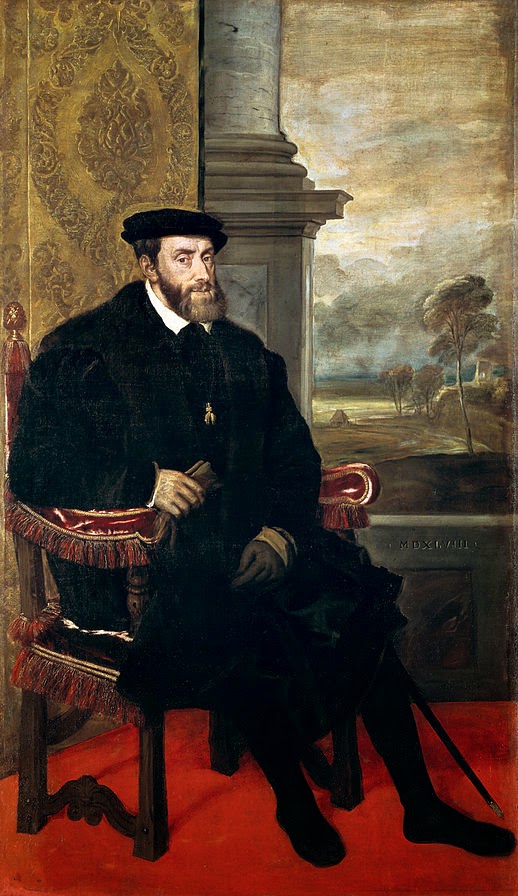
Charles V by Titian and his
colleague Lambert Sustris.
cc Wikipedia
Nothing now remained to detain Charles from that retreat for which he languished. The preparations for his voyage having been made for some time, he set out for Zuitburg, in Zealand, where the fleet which was to convoy him had orders to assemble. In his way thither he passed through Ghent, and after stopping there a few days, to indulge that tender and pleasing melancholy which arises in the mind of every man in the decline of life on visiting the place of his nativity, and viewing the scenes and objects familiar to him in his early youth, he pursued his journey, accompanied by his son Philip, his daughter the archduchess, his sisters the dowager Queens of France and Hungary, Maximilian his son-in-law, and a numerous retinue of the French nobility. Before he went on board he dismissed them with marks of his attention or regard, and, taking leave of Philip with all the tenderness of a father who embraced his son for the last time, he set sail on September 17th, under the convoy of a large fleet of Spanish, Flemish, and English ships. He declined a pressing invitation from the Queen of England to land in some part of her dominions, in order to refresh himself, and that she might have the comfort of seeing him once more. "It cannot, surely," said he, "be agreeable to a queen to receive a visit from a father-in-law who is now nothing more than a private gentleman."

Monday, November 3, 2014

Charles V’s Final Actions

Featuring William Robertson

Previously on The Peace of Augsburg and the Abdication of Charles V. And now William Robertson.

Time: 1555
Place: Augsburg, Germany

Charles V by Titian and his
colleague Lambert Sustris.
cc Wikipedia
Then, turning toward Philip, who fell on his knees and kissed his father's hand--"If," said he, "I had left you by my death this rich inheritance, to which I have made such large additions, some regard would have been justly due to my memory on that account; but now, when I voluntarily resign to you what I might have still retained, I may well expect the warmest expression of thanks on your part. With these, however, I dispense, and shall consider your concern for the welfare of your subjects, and your love of them, as the best and most acceptable testimony of your gratitude to me. It is in your power, by a wise and virtuous administration, to justify the extraordinary proof which I this day give of my paternal affection, and to demonstrate that you are worthy of the confidence which I repose in you. Preserve an inviolable regard for religion; maintain the Catholic faith in its purity; let the laws of your country be sacred in your eyes; encroach not on the rights and privileges of your people; and if the time should ever come when you shall wish to enjoy the tranquillity of private life, may you have a son endowed with such qualities that you can resign your sceptre to him with as much satisfaction as I give up mine to you."

Sunday, November 2, 2014

Charles V Formally Abdicates

Featuring William Robertson

Previously on The Peace of Augsburg and the Abdication of Charles V. And now William Robertson.

Time: 1555
Place: Augsburg, Germany

Charles V by Titian and his
colleague Lambert Sustris.
cc Wikipedia
But though Charles had revolved this scheme in his mind for several years, and had communicated it to his sisters the dowager queens of France and Hungary, who not only approved of his intention, but offered to accompany him to whatever place of retreat he should choose, several things had hitherto prevented his carrying it into execution. He could not think of loading his son with the government of so many kingdoms until he should attain such maturity of age and of abilities as would enable him to sustain that weighty burden. But as Philip had now reached his twenty-eighth year, and had been early accustomed to business, for which he discovered both inclination and capacity, it can hardly be imputed to the partiality of paternal affection that his scruples with regard to this point were entirely removed; and that he thought he might place his son, without further hesitation or delay, on the throne which he himself was about to abandon. His mother's situation had been another obstruction in his way. For although she had continued almost fifty years in confinement, and under the same disorder of mind which concern for her husband's death had brought upon her, yet the government of Spain was still vested in her jointly with the Emperor; her name was inserted, together with his, in all the public instruments issued in that kingdom; and such was the fond attachment of the Spaniards to her, that they would probably have scrupled to recognize Philip as their sovereign, unless she had consented to assume him as her partner on the throne. Her utter incapacity for business rendered it impossible to obtain her consent. But her death, which happened this year, removed this difficulty; and as Charles, upon that event, became sole monarch of Spain, it left the succession open to his son. The war with France had likewise been a reason for retaining the administration of affairs in his own hands, as he was extremely solicitous to have terminated it, that he might have given up his kingdoms to his son at peace with all the world. But as Henry had discovered no disposition to close with any of his overtures, and had even rejected proposals of peace which were equal and moderate, in a tone that seemed to indicate a fixed purpose of continuing hostilities, he saw that it was vain to wait longer in expectation of an event which, however desirable, was altogether uncertain.

Wednesday, October 29, 2014

Why Charles V Abdicated

Featuring William Robertson

Previously on The Peace of Augsburg and the Abdication of Charles V. And now William Robertson.

Time: 1555
Place: Augsburg, Germany

Charles V by Titian and his
colleague Lambert Sustris.
cc Wikipedia
The Diet of Augsburg was soon followed by the Emperor's resignation of his hereditary dominions to his son Philip; together with his resolution to withdraw entirely from any concern in business or the affairs of this world, in order that he might spend the remainder of his days in retirement and solitude. Though it requires neither deep reflection nor extraordinary discernment to discover that the state of royalty is not exempt from cares and disappointment; though most of those who are exalted to a throne find solicitude, and satiety, and disgust to be their perpetual attendants in that envied preëminence, yet to descend voluntarily from the supreme to a subordinate station, and to relinquish the possession of power in order to attain the enjoyment of happiness, seems to be an effort too great for the human mind. Several instances, indeed, occur in history, of monarchs who have quitted a throne, and have ended their days in retirement. But they were either weak princes, who took this resolution rashly, and repented of it as soon as it was taken, or unfortunate princes, from whose hands some stronger rival had wrested their sceptre, and compelled them to descend with reluctance into a private station. Diocletian is perhaps the only prince capable of holding the reins of government who ever resigned them from deliberate choice, and who continued during many years to enjoy the tranquility of retirement without fetching one penitent sigh, or casting back one look of desire toward the power or dignity which he had abandoned.

Monday, October 27, 2014

What the Augsburg Diet Decided

Featuring William Robertson

Previously on The Peace of Augsburg and the Abdication of Charles V. And now William Robertson.

Time: 1555
Place: Augsburg, Germany

Charles V by Titian and his
colleague Lambert Sustris.
cc Wikipedia
Conformably to this, a recess was framed, approved of, and published with the usual formalities. The following are the chief articles which it contained: That such princes and cities as have declared their approbation of the Confession of Augsburg shall be permitted to profess the doctrine and exercise the worship which it authorizes, without interruption or molestation from the Emperor, the King of the Romans, or any power or person whatsoever; that the Protestants, on their part, shall give no disquiet to the princes and states who adhere to the tenets and rites of the Church of Rome; that, for the future, no attempt shall be made toward terminating religious differences but by the gentle and pacific methods of persuasion and conference; that the Popish ecclesiastics shall claim no spiritual jurisdiction in such states as receive the Confession of Augsburg; that such as had seized the benefices or revenues of the Church, previous to the Treaty of Passau, shall retain possession of them, and be liable to no persecution in the imperial chamber on that account; that the supreme civil power in every state shall have right to establish what form of doctrine and worship it shall deem proper, and, if any of its subjects refuse to conform to these, shall permit them to remove with all their effects whithersoever they shall please; that if any prelate or ecclesiastic shall hereafter abandon the Romish religion, he shall instantly relinquish his diocese or benefice, and it shall be lawful for those in whom the right of nomination is vested to proceed immediately to an election, as if the office were vacant by death or translation, and to appoint a successor of undoubted attachment to the ancient system.

Such are the capital articles in this famous recess, which is the basis of religious peace in Germany, and the bond of union among its various states, the sentiments of which are so extremely different with respect to points the most interesting as well as important. In our age and nation, to which the idea of toleration is familiar, and its beneficial effects well known, it may seem strange that a method of terminating their dissensions, so suitable to the mild and charitable spirit of the Christian religion, did not sooner occur to the contending parties. But this expedient, however salutary, was so repugnant to the sentiments and practice of Christians during many ages that it did not lie obvious to discovery. Among the ancient heathens, all whose deities were local and tutelary, diversity of sentiments concerning the object or rites of religious worship seems to have been no source of animosity, because the acknowledging veneration to be due to any one god did not imply denial of the existence or the power of any other god; nor were the modes and rites of worship established in one country incompatible with those which other nations approved of and observed. Thus the errors in their system of theology were of such a nature as to be productive of concord; and, notwithstanding the amazing number of their deities, as well as the infinite variety of their ceremonies, a sociable and tolerating spirit subsisted almost universally in the Pagan world.

But when the Christian revelation declared one Supreme Being to be the sole object of religious veneration, and prescribed the form of worship most acceptable to him, whoever admitted the truth of it held, of consequence, every other system of religion, as a deviation from what was established by divine authority, to be false and impious. Hence arose the zeal of the first converts to the Christian faith in propagating its doctrines, and the ardor with which they labored to overturn every other form of worship. They employed, however, for this purpose no methods but such as suited the nature of religion. By the force of powerful arguments, they convinced the understandings of men; by the charms of superior virtue, they allured and captivated their hearts. At length the civil power declared in favor of Christianity; and though numbers, imitating the example of their superiors, crowded into the church, many still adhered to their ancient superstitions. Enraged at their obstinacy, the ministers of religion, whose zeal was still unabated, though their sanctity and virtue were much diminished, forgot so far the nature of their own mission, and of the arguments which they ought to have employed, that they armed the imperial power against these unhappy men, and, as they could not persuade, they tried to compel them to believe.


Continued on Wednesday, October 29th.

More information here.

Sunday, October 26, 2014

Why Charles V Convened the Imperial Diet

Featuring William Robertson

Previously on The Peace of Augsburg and the Abdication of Charles V. And now William Robertson.

Time: 1555
Place: Augsburg, Germany

Charles V by Titian and his
colleague Lambert Sustris.
cc Wikipedia
At the same time he stood in need of immediate and extraordinary aid from the Germanic body, as the Turks, after having wrested from him a great part of his Hungarian territories, were ready to attack the provinces still subject to his authority with a formidable army, against which he could bring no equal force into the field. For this aid from Germany he could not hope, if the internal peace of the empire were not established on a foundation solid in itself, and which should appear, even to the Protestants, so secure and so permanent as might not only allow them to engage in a distant war with safety, but might encourage them to act in it with vigor.

Wednesday, October 22, 2014

Charles V’s Brother Ferdinand at the Meeting

Featuring William Robertson

Introduction to our series The Peace of Augsburg and the Abdication of Charles V:
The Peace of Augsburg did not end the wars of the Protestant Reformation but it established a framework for how the Catholic and Protestant powers would co-exist. And now, William Robertson.

Time: 1555
Place: Augsburg, Germany

Charles V by Titian and his
colleague Lambert Sustris.
cc Wikipedia
As a diet was now necessary on many accounts, Ferdinand, about the beginning of the year 1555, had repaired to Augsburg. Though few of the princes were present either in person or by their deputies, he opened the assembly by a speech, in which he proposed a termination of the dissensions to which the new tenets and controversies with regard to religion had given rise, not only as the first and great business of the diet, but as the point which both the Emperor and he had most at heart. He represented the innumerable obstacles which the Emperor had to surmount before he could procure the convocation of a general council, as well as the fatal accidents which had for some time retarded, and had at last suspended, the consultations of that assembly. He observed that experience had already taught them how vain it was to expect any remedy for evils which demanded immediate redress from a general council, the assembling of which would either be prevented, or its deliberations be interrupted, by the dissensions and hostilities of the princes of Christendom; that a national council in Germany, which, as some imagined, might be called with greater ease, and deliberate with more perfect security, was an assembly of an unprecedented nature, the jurisdiction of which was uncertain in its extent, and the form of its proceedings undefined; that in his opinion there remained but one method for composing their unhappy differences, which, though it had been often tried without success, might yet prove effectual if it were attempted with a better and more pacific spirit than had appeared on former occasions, and that was, to choose a few men of learning, abilities, and moderation, who, by discussing the disputed articles in an amicable conference, might explain them in such a manner as to bring the contending parties either to unite in sentiment, or to differ with charity.