Showing posts with label 1601. Show all posts

Sunday, April 26, 2015

First Actor to Play Hamlet

Featuring an excerpt from an unfinished work by James Halliwell-Phillipps written before his death in 1889.

Previously in Hamlet, Drama’s Apex. And now James Halliwell-Phillipps.

Time: 1601
Place: London, Globe Theater
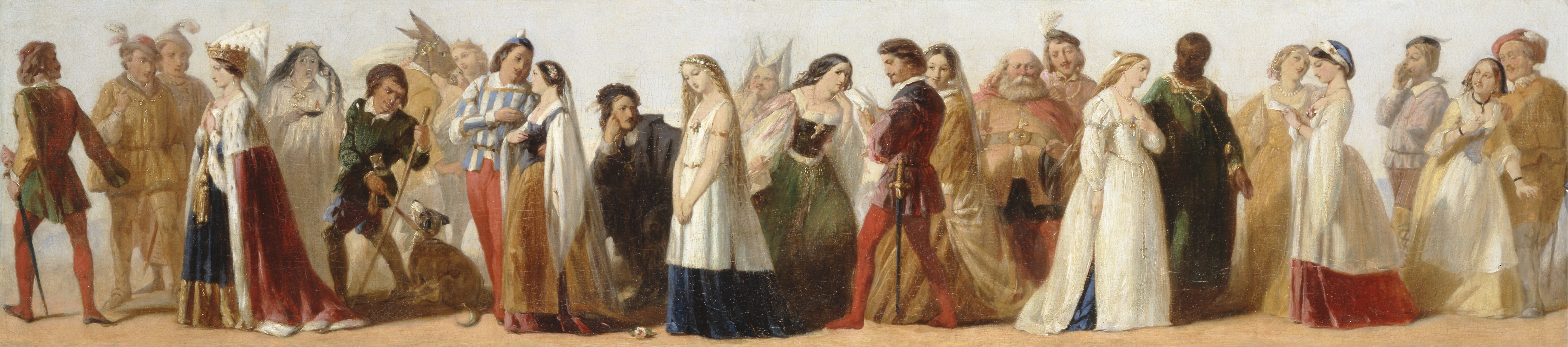
Assorted Shakespeare characters.  Public domain image from Wikipedia.
It may, however, be safely asserted that the simpler explanations are, and the less they are biased by the subtleties of the philosophical critics, the more likely they are to be in unison with the intentions of the author. Take, for instance, the well-established fact that immodesty of expression, the recollection derived, it may often be, accidentally and unwillingly from oral sources during the previous life, is one of the numerous phases of insanity; and not only are the song-fragments chanted by Ophelia, but even the ribaldry addressed to her by Hamlet, in the play-scene, vindicated, there being little doubt that Shakespeare intended the simulated madness of the latter through his intellectual supremacy to be equally true to nature, the manners of his age permitting the delineation in a form which is now repulsive and inadmissible.

The present favorite idea is that in Hamlet the great dramatist intended to delineate an irresolute mind depressed by the weight of a mission which it is unable to accomplish. This is the opinion of Goethe following, if I have noted rightly, an English writer in the Mirror of 1780. A careful examination of the tragedy will hardly sustain this hypothesis. So far from Hamlet being indecisive, although the active principle in his character is strongly influenced by the meditative, he is really a man of singular determination, and, excepting in occasional paroxsyms, one of powerful self-control. His rapidity of decision is strikingly exhibited after his first interview with the Ghost. Perceiving at once how important it was that Marcellus, at all events, should not suspect the grave revelations that had been made, although they had been sufficient to have paralyzed one of less courage and resolution than himself, he outwits his companions by banter, treating the apparition with intentional and grotesque disrespect and jocularity at a moment when an irresolute mind would have been terrified and prostrated.

Wednesday, April 22, 2015

If Another Author, It Must Be Shakespeare

Featuring an excerpt from an unfinished work by James Halliwell-Phillipps written before his death in 1889.

Previously in Hamlet, Drama’s Apex. And now James Halliwell-Phillipps.

Time: 1601
Place: London, Globe Theater

Assorted Shakespeare characters.  Public domain image from Wikipedia.
There was once in existence a copy of Speght's edition of Chaucer, 1598, with manuscript notes by Gabriel Harvey, one of those notes being in the following terms: "The younger sort take much delight in Shakespeare's Venus and Adonis, but his Lucrece and his tragedy of Hamlet, Prince of Denmarke, have it in them to please the wiser sort." This note was first printed in 1766 by Steevens, who gives the year 1598 as the date of its insertion in the volume, but, observed Dr. Ingleby, "we are unable to verify Steevens' note or collate his copy, for the book which contained Harvey's note passed into the collection of Bishop Percy, and his library was burned in the fire at Northumberland House." Under these circumstances one can only add the opinions of those who have had the opportunity of inspecting the volume. Firstly, from the letter of Percy to Malone, 1803: "In the passage which extols Shakespeare's tragedy, Spenser is quoted by name among our flourishing metricians. Now this edition of Chaucer was published in 1598, and Spenser's death is ascertained to have been in January, 1598-1599, so that these passages were all written in 1598, and prove that Hamlet was written before that year, as you have fixed it." Secondly, from a letter from Malone to Percy, written also in 1803, in which he gives reasons for controverting this opinion: "When I was in Dublin I remember you thought that, though Harvey had written 1598 in his book, it did not follow from thence that his remarks were then written; whilst, on the other hand, I contended that, from the mention of Spenser, they should seem to have been written in that year; so that, like the two Reynoldses, we have changed sides and each converted the other; for I have now no doubt that these observations were written in a subsequent year. The words that deceive are 'our now flourishing metricians,' by which Harvey does not mean 'now living,' but now admired or in vogue; and what proves this is that in his catalogue he mixes the living and the dead, for Thomas Watson was dead before 1593. With respect to Axio Philus, I think you will agree with me hereafter that not Spenser, but another person, was meant. Having more than once named Spenser, there could surely be no occasion to use any mysterious appellation with respect to that poet. My theory is that Harvey bought the book in 1598 on its publication, and then sat down to read it, and that his observations were afterward inserted at various times. That passage, which is at the very end, and subjoined to Lydgate's catalogue, one may reasonably suppose was not written till after he had perused the whole volume."

The tragedy of Hamlet is familiarly alluded to more than once in the play of Eastward Hoe, printed in 1605, in a manner which indicates that the former drama was very well established in the memories of the audience. There is a parody on one of Ophelia's songs which is of some interest in regard to the question of the critical value of the quarto of 1604; the occurrence of the word "all" before "flaxen" showing that the former word was incorrectly omitted in all the early quartos excepting in that of 1603. One of the subordinate characters in Eastward Hoe is a running-footman of the name of Hamlet, who enters in great haste to tell the coachman to be ready for his mistress, whereupon Potkin, a tankard-bearer, says: "Sfoote, Hamlet, are you madde? Whether run you nowe? You should brushe up my olde mistresse."

There is an unsupported statement by Oldys to the effect that Shakespeare received but five pounds for his tragedy of Hamlet, but whether from the company who first acted it or from the publisher is not mentioned. This is the only information that has reached us respecting the exact emolument received by Shakespeare for any of his writings, but it cannot be accepted merely on such an authority. It is, however, worthy of remark that Greene parted with his Orlando to the Queen's Players for twenty nobles; so the sum named appears to have been about the usual amount given for a play sold direct from the author to a company, but in all probability, when Hamlet was produced, Shakespeare was playing at the Globe Theatre on shares.

Notwithstanding the extreme length of the tragedy of Hamlet, there is such a marvelously concentrative power displayed in much of the construction and dialogue that, in respect to a large number of the incidents and speeches, a wide latitude of interpretation is admissible, the selection in those cases from possible explanations depending upon the judgment and temperament of each actor or reader. Hence it may be confidently predicted that no esthetic criticisms upon this drama will ever be entirely and universally accepted, and as certainly that there will remain problems in connection with it which will be subjects for discussion to the end of literary time. Among the latter the reason or reasons which induced Hamlet to defer the fulfillment of his revenge may perhaps continue to hold a prominent situation, although the solution of that special mystery does not seem to be attended with difficulties equal to those surrounding other cognate inquiries which arise in the study of the tragedy.

In respect to this drama, as to many others by the same author, the prophetic words of Leonard Digges may be usefully remembered--"Some second Shakespeare must of Shakespeare write." Until this miracle occurs, it is not likely that any esthetic criticism on the tragedy will be successful; and certainly at present, notwithstanding the numbers of persons of high talent and genius who have discussed the subject, nothing has been, nor is likely to be, produced which is altogether satisfactory. The cause of this may perhaps to some extent arise from the latitude of interpretation the dramatic form of composition allows, to the appreciation of the minor details of a character, and the various plausible reasons that can often be assigned for the same line of action; something also may be due to the unconscious influence exercised by individual temperament upon the exposition of that character, and again much to the defective state of the text; but the reason of the general failure in Hamlet criticism is no doubt chiefly to be traced to the want of ability to enter fully into the inspiration of the poet's genius.


Continued on Sunday, April 26th.

Text of play here.

Monday, April 20, 2015

When was Shakespeare’s Hamlet Produced?

Featuring an excerpt from an unfinished work by James Halliwell-Phillipps written before his death in 1889.

Previously in Hamlet, Drama’s Apex. And now James Halliwell-Phillipps.

Time: 1601
Place: London, Globe Theater

Assorted Shakespeare characters.  Public domain image from Wikipedia.
Mr. Collier, in his Farther Particulars, 1839, cites a very curious passage--"a trout, Hamlet, with four legs"--which is given as a proverbial line in Clarke's Paroemiologia Anglo-Latina (or Proverbs English and Latin), 1639. It is unnecessary to be too curious in searching for the exact meaning of the phrase, but, as Dr. Ingleby suggested to me, it is in all probability taken from the older play of Hamlet, which does not appear to have been entirely superseded at once by the new, or at least was long remembered by play-goers.

The preceding notices may fairly authorize us to infer that the ancient play of Hamlet--1. Was written by either an attorney or an attorney's clerk, who had not received a university education; 2. Was full of tragical, high-sounding speeches; 3. Contained the passage "There are things called whips in store," spoken by Hamlet; 4. Included a very telling brief speech by the Ghost in the two words "Hamlet, revenge!" 5. Was acted at the theatre in Shoreditch and at the playhouse at Newington Butts; 6. Had for its principal character a hero exhibiting more general violence than can be attributed to Shakespeare's creation of Hamlet.

Sunday, April 19, 2015

Shakespeare’s Masterpiece, Hamlet

Featuring an excerpt from an unfinished work by James Halliwell-Phillipps written before his death in 1889.

Introduction to our series Hamlet, Drama’s Apex:
The tragedy of Hamlet is generally regarded by critics as Shakespeare's masterpiece. Hence it is often referred to as the highest literary product of human genius. In the following discussion of the play, Mr. J. O. Halliwell-Phillipps, the master and dean of later Shakespearean scholars, gives 1601 as the probable date of its first production. At that time Shakespeare was a London actor, and leading shareholder in the Globe Theatre, where his play was presumably produced. He had made his first big success some five years before with Romeo and Juliet, and was, so far as we can judge, on the high tide of financial prosperity. The profession of an actor carried with it in those days much discredit, but in his far-off home at Stratford, Shakespeare had in 1601 already begun to seek the repute of a country gentleman, and had purchased the finest house and estate in the little village. And now, James Halliwell-Phillipps


Time: 1601
Place: London, Globe Theater

Assorted Shakespeare characters.  Public domain image from Wikipedia.
The tragedy of Hamlet is unquestionably the highest effort of artistic literary power yet given to the world. There is nothing to be found in real competition with it excepting in the other works of Shakespeare, but all are inferior to this great masterpiece. There is hardly a speech in the whole play which may not fairly be made the subject of an elaborate discourse, especially when viewed in connection with its bearings, however occasionally remote, on the character of Hamlet, the development of which appears to have been the chief object of the author, not only in the management of the plot, but in the creation of the other personages who are introduced. There is contemporary evidence to this effect in the Stationers' Register of 1602 in the title there given--The Revenge of Hamlet.

There was an old English tragedy on the subject of Hamlet which was in existence at least as early as the year 1589, in the representation of which an exclamation of the Ghost--"Hamlet, revenge!"--was a striking and well-remembered feature. This production is alluded to in some prefatory matter by Nash in the edition of Greene's Menaphon, issued in that year, here given: "I'le turne backe to my first text, of studies of delight, and talke a little in friendship with a few of our triuiall translators. It is a common practise now a daies amongst a sort of shifting companions that run through euery arte and thriue by none, to leaue the trade of Nouerint whereto they were borne, and busie themselues with the indeuors of art, that could scarcelie latinize their necke-verse if they should haue neede; yet English Seneca read by candle light yeeldes manie good sentences, as Bloud is a beggar, and so foorth: and if you intreate him faire in a frostie morning, he will afoord you whole Hamlets, I should say hand-fulls of tragical speeches."