Monday, December 8, 2014

Confucius the Minister of Crime

Featuring Robert K. Douglas

Previously on Confucius. And now, Robert K. Douglas.

Time: 551 BC - 479 BC
Place: China

cc Wikipedia
Courage was recognized by Confucius as being one of the great virtues, and about this period we have related two instances in which he showed that he possessed both moral and physical courage to a high degree. The chief of the Ke family, being virtual possessor of the state, when the body of the exiled Duke Chaou was brought from T'se for interment, directed that it should be buried apart from the graves of his ancestors. On Confucius becoming aware of his decision, he ordered a trench to be dug round the burying-ground which should enclose the new tomb. "Thus to censure a prince and signalize his faults is not according to etiquette," said he to Ke. "I have caused the grave to be included in the cemetery, and I have done so to hide your disloyalty." And his action was allowed to pass unchallenged.

Sunday, December 7, 2014

Confucius Becomes a Teacher

Featuring Robert K. Douglas

Previously on Confucius. And now, Robert K. Douglas.

Time: 551 BC - 479 BC
Place: China

cc Wikipedia
It was possibly in connection with this incident that Confucius drew the attention of his disciples to the metal statue of a man with a triple clasp upon his mouth, which stood in the ancestral temple at Lo. On the back of the statue were inscribed these words: "The ancients were guarded in their speech, and like them we should avoid loquacity. Many words invite many defeats. Avoid also engaging in many businesses, for many businesses create many difficulties."

Saturday, December 6, 2014

Video Games as a Media For History

Video games can be a great educational tool.  Creators have to balance game play against accuracy in order to make their products commercially viable.  This makes this media questionable.

Here's an essay from The French Revolution Network on the game Assassin's Creed.

Thursday, December 4, 2014

When Society Stands Still

"In periods where there is no leadership, society stands still. Progress occurs when courageous, skillful leaders seize the opportunity to change things for the better."

- Harry Truman

More on Harry Truman.

Picture public domain from Wikipedia

Wednesday, December 3, 2014

The Young Confucius

Featuring Robert K. Douglas

Previously on Confucius. And now, Robert K. Douglas.

Time: 551 BC - 479 BC
Place: China

cc Wikipedia
Report says that the child was born in a cave on Mount Ne, whither Ching-tsai went in obedience to a vision to be confined. But this is but one of the many legends with which Chinese historians love to surround the birth of Confucius. With the same desire to glorify the Sage, and in perfect good faith, they narrate how the event was heralded by strange portents and miraculous appearances, how genii announced to Ching-tsai the honor that was in store for her, and how fairies attended at his nativity.

Tuesday, December 2, 2014

Murder’s Aftermath

Previously in Herodotus

79. So when they had slain the Magians and cut off their heads, they left behind those of their number who were wounded, both because they were unable to go, and also in order that they might take charge of the fortress, and the five others taking with them the heads of the Magians ran with shouting and clashing of arms and called upon the other Persians to join them, telling them of that which had been done and showing the heads, and at the same time they proceeded to slay every one of the Magians who crossed their path. So the Persians when they heard of that which had been brought to pass by the seven and of the deceit of the Magians, thought good themselves also to do the same, and drawing their daggers they killed the Magians wherever they found one; so that if night had not come on and stopped them, they would not have left a single Magian alive. This day the Persians celebrate in common more than all other days, and upon it they keep a great festival which is called by the Persians the festival of the slaughter of the Magians, on which no Magian is permitted to appear abroad, but the Magians keep themselves within their houses throughout that day.

Monday, December 1, 2014

China at the Confucius’ Birth

Featuring Robert K. Douglas

Introduction to our series Confucius:
He began as a political reformer, became a statesman, an administrator and then one of history’s greatest philosophers. His legacy was a revolution for China. And now, Robert K. Douglas.


Time: 551 BC - 479 BC
Place: China

cc Wikipedia
At the time of which we write the Chinese were still clinging to the banks of the Yellow River, along which they had first entered the country, and formed, within the limits of China proper, a few states on either shore lying between the 33d and 38th parallels of latitude, and the 106th and 119th of longitude. The royal state of Chow occupied part of the modern province of Honan. To the north of this was the powerful state of Tsin, embracing the modern province of Shanse and part of Chili; to the south was the barbarous state of Ts'oo, which stretched as far as the Yang-tsze-kiang; to the east, reaching to the coast, were a number of smaller states, among which those of Ts'e, Loo, Wei, Sung, and Ching were the chief and to the west of the Yellow River was the state of Ts'in, which was destined eventually to gain the mastery over the contending principalities.

Sunday, November 30, 2014

The Battle of the Boyne Ends

Featuring Tobias G. Smollett

Previously on Siege of Londonderry and the Battle of the Boyne. And now Tobias G. Smollett.

Time: 1690
Place: Londonderry, Ireland and the River Boyne, Ireland

cc. Wikipedia
Then the Duke of Schomberg passed the river in person, put himself at the head of the French Protestants, and pointing to the enemy, "Gentlemen," said he, "those are your persecutors." With these words he advanced to the attack, where he himself sustained a violent onset from a party of the Irish horse, which had broken through one of the regiments and were now on their return. They were mistaken for English, and allowed to gallop up to the Duke, who received two severe wounds in the head; but the French troops, now sensible of their mistake, rashly threw in their fire on the Irish while they were engaged with the Duke, and, instead of saving, shot him dead on the spot.

Saturday, November 29, 2014

Teaching Women's History

A symposium in England is reported on in the FWSA Blog.  I am still waiting for the results of the men's symposium but I digress.

Thursday, November 27, 2014

Thanksgiving, 2014


From History News Network here is an old 2001 post by Rick Shenkman exploding some commonly held myths.  Like any article of this kind, remember that just because some author declares something to be a myth does not mean that it actually is.

Hence my picture, not that I believe that the pilgrims dressed in black but to make the point.

Wednesday, November 26, 2014

The Battle of the Boyne Begins

Featuring Tobias G. Smollett

Previously on Siege of Londonderry and the Battle of the Boyne. And now Tobias G. Smollett.

Time: 1690
Place: Londonderry, Ireland and the River Boyne, Ireland

cc. Wikipedia
King James trusted so much to the disputes in the English Parliament that he did not believe his son-in-law would be able to quit that kingdom, and William had been six days in Ireland before he received intimation of his arrival. This was no sooner known than he left Dublin under the guard of the militia, commanded by Luttrel, and, with a reinforcement of six thousand infantry which he had lately received from France, joined the rest of his forces, which now almost equalled William's army in number, exclusive of about fifteen thousand men who remained in different garrisons. He occupied a very advantageous post on the bank of the Boyne, and, contrary to the advice of his general officers, resolved to stand battle. They proposed to strengthen their garrisons, and retire to the Shannon, to wait the effect of the operations at sea.

Tuesday, November 25, 2014

Darius Thrusts His Dagger into the Emperor

Previously in Herodotus

74. Now while these were thus taking counsel together, it was coming to pass by coincidence as follows:—The Magians taking counsel together had resolved to join Prexaspes with themselves as a friend, both because he had suffered grievous wrong from Cambyses, who had killed his son by shooting him, and because he alone knew for a certainty of the death of Smerdis the son of Cyrus, having killed him with his own hands, and finally because Prexaspes was in very great repute among the Persians. For these reasons they summoned him and endeavoured to win him to be their friend, engaging him by pledge and with oaths, that he would assuredly keep to himself and not reveal to any man the deception which had been practised by them upon the Persians, and promising to give him things innumerable 64 in return. After Prexaspes had promised to do this, the Magians, having persuaded him so far, proposed to him a second thing, and said that they would call together all the Persians to come up to the wall of the palace, and bade him go up upon a tower and address them, saying that they were living under the rule of Smerdis the son of Cyrus and no other. This they so enjoined because they supposed 65 that he had the greatest credit among the Persians, and because he had frequently declared the opinion that Smerdis the son of Cyrus was still alive, and had denied that he had slain him.

Monday, November 24, 2014

The Siege of Londonderry Ends

Featuring Tobias G. Smollett

Previously on Siege of Londonderry and the Battle of the Boyne. And now Tobias G. Smollett.

Time: 1690
Place: Londonderry, Ireland and the River Boyne, Ireland

cc. Wikipedia
At length a reinforcement arrived in the Lough, under the command of General Kirke, who had deserted his master, and been employed in the service of King William. He found means to convey intelligence to Walker that he had troops and provisions on board for their relief, but found it impracticable to sail up the river. He promised, however, that he would land a body of forces at the Inch, and endeavor to make a diversion in their favor, when joined by the troops at Inniskillen, which amounted to five thousand men, including two thousand cavalry. He said he expected six thousand men from England, where they were embarked before he set sail; he exhorted them to persevere in their courage and loyalty, and assured them that he would come to their relief at all hazards. The assurances enabled them to bear their miseries a little longer, though their numbers daily diminished. Major Baker dying, his place was filled by Colonel Michelburn, who now acted as colleague to Mr. Walker.

Sunday, November 23, 2014

The Siege of Londonderry Begins

Featuring Tobias G. Smollett

Introduction to our series Siege of Londonderry and the Battle of the Boyne:
King James II lost the throne of England in the Glorious Revolution of 1688. James had the support of the Catholic Irish. His opponent; King William had the support of the Protestant English. Hoping to use Ireland as a base in the war to regain his throne, James counter-attacked in Ireland. His first objective was the town of Londonderry, inhabited by English Protestants. Rumors reached the town that James intended to kill all the inhabitants.

Tobias Smollett (1721-1771) in his Complete History of England gives one of the best accounts of this campaign. And now, Tobias G. Smollett.


Time: 1690
Place: Londonderry, Ireland and the River Boyne, Ireland

cc. Wikipedia
On the first alarm of an intended massacre, the Protestants of Londonderry had shut their gates against the regiment commanded by the Earl of Antrim, and resolved to defend themselves against the Lord Deputy; they transmitted this resolution to the Government of England, together with an account of the danger they incurred by such a vigorous measure, and implored immediate assistance; they were accordingly supplied with some arms and ammunition, but did not receive any considerable reënforcement till the middle of April, when two regiments arrived at Loughfoyl under the command of Cunningham and Richards.

Saturday, November 22, 2014

Top Ten Most Evil Dictators of All Time

I mostly agree with this list.  Most people killed is the measure used to determine the order.  Problem with this method is that some dictators operated in smaller areas and eras with smaller populations.  In addition, some dictators were in power longer than others and hence could do more killing.

A percentage method would have been better.

Kudos to Juan Carlos Pineiro Escoriaza of PopTen.

Thursday, November 20, 2014

Choose Their Own Leader

Princeton 1935
"The led must not be compelled. They must be able to choose their own leader

- Albert Einstein

More on Albert Einstein.

Picture public domain from Wikipedia

Wednesday, November 19, 2014

The Secret of Cervantes’ Success

Featuring Henry Edward Watts

Previously on Cervantes' "Don Quixote" Reforms Literature. And now Henry Edward Watts

Time: 1605
Place: Spain


The adventure was one reserved for his single arm; and it was achieved with a completeness of success such as must have astonished our hero himself, as we know by many signs that it disgusted and irritated many of his literary rivals. The true nature of the service performed, as well as Cervantes' motive in undertaking it, has been greatly misrepresented. Nothing can be more certain than that his aim in Don Quixote was, primarily, to correct the prevailing false taste in literature. What moral and social results followed were the necessary consequences of the employment of his rare wit and humor on such a work. There is no reason to believe that Cervantes, at first, had any more serious intention than that which he avowed, namely, to give "a pastime to melancholy souls"[19] in destroying "the authority and influence which the books of chivalries have in the world and over the vulgar." That he was not impelled to this work by any antipathy to knightly romances as such--still less by any ambition to repress the spirit of chivalry, or to purge the commonwealth of social and political abuses--is abundantly proved by the whole tenor of his book, if not by the evidence of his life. His own tastes strongly inclined him to books of romance. Perhaps no one in that age had read more of those books, or was so deeply imbued with their spirit.

Tuesday, November 18, 2014

Darius and His Six Conspirators

Previously in Herodotus

70. Then Otanes took to him Aspathines and Gobryas, who were leading men among the Persians and also his own most trusted friends, and related to them the whole matter: and they, as it then appeared, had suspicions also themselves that it was so; and when Otanes reported this to them, they readily accepted his proposals. Then it was resolved by them that each one should associate with himself that man of the Persians whom he trusted most; so Otanes brought in Intaphrenes, Gobryas brought in Megabyzos, and Aspathines brought in Hydarnes. When they had thus become six, Darius the son of Hystaspes arrived at Susa, having come from the land of Persia, for of this his father was governor. Accordingly when he came, the six men of the Persians resolved to associate Darius also with themselves.

Monday, November 17, 2014

Comparing the Book “Don Quixote” to Other Books of the Period

Featuring Henry Edward Watts

Previously on Cervantes' "Don Quixote" Reforms Literature. And now Henry Edward Watts

Time: 1605
Place: Spain


To estimate the worth of the service performed by Cervantes--not in abolishing romance, as has been absurdly said, still less in discrediting chivalry, as with even a more perverse misconception of his purpose has been suggested, but in purging books of fiction of their grossness and their extravagance, and restoring romance to truth and to nature--we have to consider the enormous influence exercised by this pernicious literature over the minds of the people of Spain in the sixteenth century.

Sunday, November 16, 2014

The Book “Don Quixote’s” Theme

Featuring Henry Edward Watts

Previously on Cervantes' "Don Quixote" Reforms Literature. And now Henry Edward Watts

Time: 1605
Place: Spain


Taking the object of Don Quixote to be, what Cervantes declared it--"the causing of the false and silly books of chivalries to be abhorred by mankind"--no book was ever so successful. The doughtiest knight of romance never achieved an adventure so stupendous as that which Miguel de Cervantes undertook and accomplished. With his pen, keener than the lance of Esplandian or Felixmarte, he slew the whole herd of puissant cavaliers, of very valiant and accomplished lovers. Before him went down the Florisandros and Florisels, the Lisuartes and Lepolemos, the Primaleons and the Polindos, and the whole brood of the invincible. Scarcely a single romance was printed, and not one was written, after the date of the publication of Don Quixote.[14] Such a revolution in taste was never accomplished by any single writer, in any age or country.

Saturday, November 15, 2014

Friday, November 14, 2014

Sherman Begins March to the Sea Across Georgia

November 12 was the 150th. anniversary of the burning of Atlanta and total war on the south.  This Real Clear History article describes the march.

Thursday, November 13, 2014

Assault Is Not Leadership

Official Portrait Photo, 1959
"You do not lead by hitting people over the head. That's assault, not leadership."

- Dwight D. Eisenhower

More on Dwight D. Eisenhower.

Picture public domain from Wikipedia

Wednesday, November 12, 2014

Critical and Public Reception of the Book “Don Quixote”

Featuring Henry Edward Watts

Previously on Cervantes' "Don Quixote" Reforms Literature. And now Henry Edward Watts

Time: 1605
Place: Spain


The reception which Don Quixote met with on its first appearance was cordial beyond all precedent, and such as must have convinced the author, who was evidently doubtful of his new experiment, that here at last his genius had found its true field of exercise. The persons of culture, indeed, received the book coldly. The half-learned sneered at the title as absurd and at the style as vulgar. Who was this ingenio lego--this lay, unlearned wit--"a poor Latin-less author," which is what they said of Shakespeare--outside of the cultos proper, of no university education--who had dared to parody the tastes of the higher circles? The envy and malice of all his rivals--especially of those who found themselves included in the satire--even the great Lope himself, the phoenix of his age, then at the height of his glory--spoke out, with open mouth, against the author. The chorus of dispraise was swelled by all those, persons chiefly of high station, whose fashion of reading had been ridiculed. A book, professing to be of entertainment, in which knights and knightly exercises were made a jest of--in which peasants, innkeepers, muleteers, and other vulgar people spoke their own language and behaved after their own fashion--was a daring innovation, all the more offensive because the laugh was directed at what was felt to be a national infirmity. Who was the bold man who, being neither courtier nor ecclesiastic, made sport for the world out of the weaknesses of caballeros? An old soldier of Lepanto, indeed! Lepanto was a name outworn. Spain was now in a new world. Crusades against the unbeliever, even those more popular ones which combined the saving of souls with the getting of gold, were long out of fashion. Lastly, the entire ecclesiastical body--the formidable phalanx of the endowed, with their patrons dependents, and dupes--though they were too dull to perceive and too dense to feel the shafts aimed at obscurantism and superstition, had something more than a suspicion that this book called Don Quixote was a book to be discouraged.

Tuesday, November 11, 2014

Veterans Day, 2014


There are two holidays honoring our armed forces: Memorial Day for those who died and Veterans Day for the rest.  I worry that we have too many holidays and therefore the significance of each individual one gets lost on the average American.  Most people do not seem to take this day off work.

Monday, November 10, 2014

How Don Quixote Got Published

Featuring Henry Edward Watts

Previously on Cervantes' "Don Quixote" Reforms Literature. And now Henry Edward Watts

Time: 1605
Place: Spain


In 1601 Philip III, at the instance of the Duke of Lerma, removed the court to the old capital of Castile, Valladolid--by nature far better situated for a metropolis than Madrid, which had been the choice of his grandfather, Charles V. Thither Cervantes repaired, in 1603, doubtless with some hope of gleaning some crumbs of the royal favor. He was no more fortunate with the new King than he had been with the old. Despairing of place or patronage, he turned, with his brave spirit unquenched as by the record sufficiently appears, to completing this new thing among books.

Sunday, November 9, 2014

Cervantes’ Severe Ordeal

Featuring Henry Edward Watts

Introduction to our series Cervantes' "Don Quixote" Reforms Literature:
The fame of the most celebrated Spanish author rests upon a far more solid basis than merely that of having written the most readable and tender of humorous romances. He reformed literature. He tilted at windmills as truly as ever his hero did. And now, Henry Edward Watts

Time: 1605
Place: Spain


The accession of the new King, which had been hailed as "the light after darkness," had little effect on Cervantes' fortunes. Philip III, though he had some taste for letters, and was not without sprouts of kindliness in his heart, had been by education and by an over-strict regimen in youth debased, so that he was even more completely a slave to the priestly influence than his father had been, without any of his father's ability or force of character. The Duke of Lerma was "the Atlas who bore the burden of the monarchy."[1] He was a man, according to Quevedo, "alluring and dexterous rather than intelligent; ruled by the interested cunning of his own creatures but imperious with all others; magnificent, ostentatious; choosing his men only by considerations of his own special policy or from personal friendship." Under such a man, who ruled the King at his will, it was not likely that any portion of the royal benevolence should light on Miguel de Cervantes. Moreover, the crowd of suppliants at court was very great, their appetite stimulated doubtless by the flattering reports of the new King's liberal disposition.

Saturday, November 8, 2014

Europe's History Map

Another inter-active map from Worldology, this one covers the entire history of Europe.

Thursday, November 6, 2014

Patton on Leadership

"Never tell people how to do things. Tell them what to do, and they will surprise you with their ingenuity."

- General George S. Patton

More on General George S. Patton.

Picture public domain from Wikipedia

Wednesday, November 5, 2014

Last Voyage of Charles V

Featuring William Robertson

Previously on The Peace of Augsburg and the Abdication of Charles V. And now William Robertson.

Time: 1555
Place: Augsburg, Germany
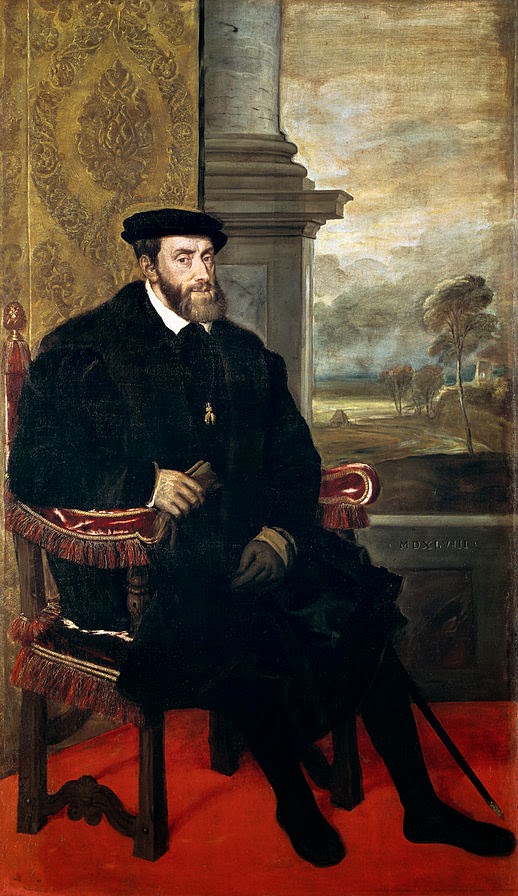
Charles V by Titian and his
colleague Lambert Sustris.
cc Wikipedia
Nothing now remained to detain Charles from that retreat for which he languished. The preparations for his voyage having been made for some time, he set out for Zuitburg, in Zealand, where the fleet which was to convoy him had orders to assemble. In his way thither he passed through Ghent, and after stopping there a few days, to indulge that tender and pleasing melancholy which arises in the mind of every man in the decline of life on visiting the place of his nativity, and viewing the scenes and objects familiar to him in his early youth, he pursued his journey, accompanied by his son Philip, his daughter the archduchess, his sisters the dowager Queens of France and Hungary, Maximilian his son-in-law, and a numerous retinue of the French nobility. Before he went on board he dismissed them with marks of his attention or regard, and, taking leave of Philip with all the tenderness of a father who embraced his son for the last time, he set sail on September 17th, under the convoy of a large fleet of Spanish, Flemish, and English ships. He declined a pressing invitation from the Queen of England to land in some part of her dominions, in order to refresh himself, and that she might have the comfort of seeing him once more. "It cannot, surely," said he, "be agreeable to a queen to receive a visit from a father-in-law who is now nothing more than a private gentleman."

Tuesday, November 4, 2014

The Magian Becomes King

Previously in Herodotus

66. And the Persians, when they saw that the king had begun to bewail himself, both rent the garments which they wore and made lamentation without stint. After this, when the bone had become diseased and the thigh had mortified, Cambyses the son of Cyrus was carried off by the wound, having reigned in all seven years and five months, and being absolutely childless both of male and female offspring. The Persians meanwhile who were present there were very little disposed to believe that the power was in the hands of the Magians: on the contrary, they were surely convinced that Cambyses had said that which he said about the death of Smerdis to deceive them, in order that all the Persians might be moved to war against him. These then were surely convinced that Smerdis the son of Cyrus was established to be king; for Prexaspes also very strongly denied that he had slain Smerdis, since it was not safe, now that Cambyses was dead, for him to say that he had destroyed with his own hand the son of Cyrus.

Monday, November 3, 2014

Charles V’s Final Actions

Featuring William Robertson

Previously on The Peace of Augsburg and the Abdication of Charles V. And now William Robertson.

Time: 1555
Place: Augsburg, Germany

Charles V by Titian and his
colleague Lambert Sustris.
cc Wikipedia
Then, turning toward Philip, who fell on his knees and kissed his father's hand--"If," said he, "I had left you by my death this rich inheritance, to which I have made such large additions, some regard would have been justly due to my memory on that account; but now, when I voluntarily resign to you what I might have still retained, I may well expect the warmest expression of thanks on your part. With these, however, I dispense, and shall consider your concern for the welfare of your subjects, and your love of them, as the best and most acceptable testimony of your gratitude to me. It is in your power, by a wise and virtuous administration, to justify the extraordinary proof which I this day give of my paternal affection, and to demonstrate that you are worthy of the confidence which I repose in you. Preserve an inviolable regard for religion; maintain the Catholic faith in its purity; let the laws of your country be sacred in your eyes; encroach not on the rights and privileges of your people; and if the time should ever come when you shall wish to enjoy the tranquillity of private life, may you have a son endowed with such qualities that you can resign your sceptre to him with as much satisfaction as I give up mine to you."

Sunday, November 2, 2014

Charles V Formally Abdicates

Featuring William Robertson

Previously on The Peace of Augsburg and the Abdication of Charles V. And now William Robertson.

Time: 1555
Place: Augsburg, Germany

Charles V by Titian and his
colleague Lambert Sustris.
cc Wikipedia
But though Charles had revolved this scheme in his mind for several years, and had communicated it to his sisters the dowager queens of France and Hungary, who not only approved of his intention, but offered to accompany him to whatever place of retreat he should choose, several things had hitherto prevented his carrying it into execution. He could not think of loading his son with the government of so many kingdoms until he should attain such maturity of age and of abilities as would enable him to sustain that weighty burden. But as Philip had now reached his twenty-eighth year, and had been early accustomed to business, for which he discovered both inclination and capacity, it can hardly be imputed to the partiality of paternal affection that his scruples with regard to this point were entirely removed; and that he thought he might place his son, without further hesitation or delay, on the throne which he himself was about to abandon. His mother's situation had been another obstruction in his way. For although she had continued almost fifty years in confinement, and under the same disorder of mind which concern for her husband's death had brought upon her, yet the government of Spain was still vested in her jointly with the Emperor; her name was inserted, together with his, in all the public instruments issued in that kingdom; and such was the fond attachment of the Spaniards to her, that they would probably have scrupled to recognize Philip as their sovereign, unless she had consented to assume him as her partner on the throne. Her utter incapacity for business rendered it impossible to obtain her consent. But her death, which happened this year, removed this difficulty; and as Charles, upon that event, became sole monarch of Spain, it left the succession open to his son. The war with France had likewise been a reason for retaining the administration of affairs in his own hands, as he was extremely solicitous to have terminated it, that he might have given up his kingdoms to his son at peace with all the world. But as Henry had discovered no disposition to close with any of his overtures, and had even rejected proposals of peace which were equal and moderate, in a tone that seemed to indicate a fixed purpose of continuing hostilities, he saw that it was vain to wait longer in expectation of an event which, however desirable, was altogether uncertain.

Saturday, November 1, 2014

All Saints Day, 2014


The article I link to uses the unfortunate word "cult" which I suppose reflects the general unfashionabiltiy of religion among the academics.  Are fans of today's celebrities "cultists"?

Except for that caveat, I suggest you read this article from Jonathan Jarrett's A Corner of Tenth Century Europe blog for All Saints Day.

Friday, October 31, 2014

Halloween, 2014

Halloween is a good time to link to this story about a house that was used to detain enemy spies.  Who lurks inside now?

This is from the History@Kingston blog.

Thursday, October 30, 2014

The Greatest Force in the Universe

I believe that prayer is our powerful contact with the greatest force in the universe.

- Loretta Young

More on Loretta Young.

Picture public domain from Wikipedia

Wednesday, October 29, 2014

Why Charles V Abdicated

Featuring William Robertson

Previously on The Peace of Augsburg and the Abdication of Charles V. And now William Robertson.

Time: 1555
Place: Augsburg, Germany

Charles V by Titian and his
colleague Lambert Sustris.
cc Wikipedia
The Diet of Augsburg was soon followed by the Emperor's resignation of his hereditary dominions to his son Philip; together with his resolution to withdraw entirely from any concern in business or the affairs of this world, in order that he might spend the remainder of his days in retirement and solitude. Though it requires neither deep reflection nor extraordinary discernment to discover that the state of royalty is not exempt from cares and disappointment; though most of those who are exalted to a throne find solicitude, and satiety, and disgust to be their perpetual attendants in that envied preëminence, yet to descend voluntarily from the supreme to a subordinate station, and to relinquish the possession of power in order to attain the enjoyment of happiness, seems to be an effort too great for the human mind. Several instances, indeed, occur in history, of monarchs who have quitted a throne, and have ended their days in retirement. But they were either weak princes, who took this resolution rashly, and repented of it as soon as it was taken, or unfortunate princes, from whose hands some stronger rival had wrested their sceptre, and compelled them to descend with reluctance into a private station. Diocletian is perhaps the only prince capable of holding the reins of government who ever resigned them from deliberate choice, and who continued during many years to enjoy the tranquility of retirement without fetching one penitent sigh, or casting back one look of desire toward the power or dignity which he had abandoned.

Tuesday, October 28, 2014

Cambyses Hears of Smerdis

Previously in Herodotus


63. When Prexaspes had thus spoken, Cambyses was pleased with the advice, and accordingly the herald was pursued forthwith and returned. Then when he had come back, Prexaspes asked him as follows: "Man, thou sayest that thou art come as a messenger from Smerdis the son of Cyrus: now therefore speak the truth and go away in peace. I ask thee whether Smerdis himself appeared before thine eyes and charged thee to say this, or some one of those who serve him." He said: "Smerdis the son of Cyrus I have never yet seen, since the day that king Cambyses marched to Egypt: but the Magian whom Cambyses appointed to be guardian of his household, he, I say, gave me this charge, saying that Smerdis the son of Cyrus was he who laid the command upon me to speak these things to you." Thus he spoke to them, adding no falsehoods to the first, and Cambyses said: "Prexaspes, thou hast done that which was commanded thee like an honest man, and hast escaped censure; but who of the Persians may this be who has risen up against me and usurped the name of Smerdis?" He said: "I seem to myself, O king, to have understanding of this which has come to pass: the Magians have risen against thee, Patizeithes namely, whom thou didst leave as caretaker of thy household, and his brother Smerdis."

Monday, October 27, 2014

What the Augsburg Diet Decided

Featuring William Robertson

Previously on The Peace of Augsburg and the Abdication of Charles V. And now William Robertson.

Time: 1555
Place: Augsburg, Germany

Charles V by Titian and his
colleague Lambert Sustris.
cc Wikipedia
Conformably to this, a recess was framed, approved of, and published with the usual formalities. The following are the chief articles which it contained: That such princes and cities as have declared their approbation of the Confession of Augsburg shall be permitted to profess the doctrine and exercise the worship which it authorizes, without interruption or molestation from the Emperor, the King of the Romans, or any power or person whatsoever; that the Protestants, on their part, shall give no disquiet to the princes and states who adhere to the tenets and rites of the Church of Rome; that, for the future, no attempt shall be made toward terminating religious differences but by the gentle and pacific methods of persuasion and conference; that the Popish ecclesiastics shall claim no spiritual jurisdiction in such states as receive the Confession of Augsburg; that such as had seized the benefices or revenues of the Church, previous to the Treaty of Passau, shall retain possession of them, and be liable to no persecution in the imperial chamber on that account; that the supreme civil power in every state shall have right to establish what form of doctrine and worship it shall deem proper, and, if any of its subjects refuse to conform to these, shall permit them to remove with all their effects whithersoever they shall please; that if any prelate or ecclesiastic shall hereafter abandon the Romish religion, he shall instantly relinquish his diocese or benefice, and it shall be lawful for those in whom the right of nomination is vested to proceed immediately to an election, as if the office were vacant by death or translation, and to appoint a successor of undoubted attachment to the ancient system.

Such are the capital articles in this famous recess, which is the basis of religious peace in Germany, and the bond of union among its various states, the sentiments of which are so extremely different with respect to points the most interesting as well as important. In our age and nation, to which the idea of toleration is familiar, and its beneficial effects well known, it may seem strange that a method of terminating their dissensions, so suitable to the mild and charitable spirit of the Christian religion, did not sooner occur to the contending parties. But this expedient, however salutary, was so repugnant to the sentiments and practice of Christians during many ages that it did not lie obvious to discovery. Among the ancient heathens, all whose deities were local and tutelary, diversity of sentiments concerning the object or rites of religious worship seems to have been no source of animosity, because the acknowledging veneration to be due to any one god did not imply denial of the existence or the power of any other god; nor were the modes and rites of worship established in one country incompatible with those which other nations approved of and observed. Thus the errors in their system of theology were of such a nature as to be productive of concord; and, notwithstanding the amazing number of their deities, as well as the infinite variety of their ceremonies, a sociable and tolerating spirit subsisted almost universally in the Pagan world.

But when the Christian revelation declared one Supreme Being to be the sole object of religious veneration, and prescribed the form of worship most acceptable to him, whoever admitted the truth of it held, of consequence, every other system of religion, as a deviation from what was established by divine authority, to be false and impious. Hence arose the zeal of the first converts to the Christian faith in propagating its doctrines, and the ardor with which they labored to overturn every other form of worship. They employed, however, for this purpose no methods but such as suited the nature of religion. By the force of powerful arguments, they convinced the understandings of men; by the charms of superior virtue, they allured and captivated their hearts. At length the civil power declared in favor of Christianity; and though numbers, imitating the example of their superiors, crowded into the church, many still adhered to their ancient superstitions. Enraged at their obstinacy, the ministers of religion, whose zeal was still unabated, though their sanctity and virtue were much diminished, forgot so far the nature of their own mission, and of the arguments which they ought to have employed, that they armed the imperial power against these unhappy men, and, as they could not persuade, they tried to compel them to believe.


Continued on Wednesday, October 29th.

More information here.

Sunday, October 26, 2014

Why Charles V Convened the Imperial Diet

Featuring William Robertson

Previously on The Peace of Augsburg and the Abdication of Charles V. And now William Robertson.

Time: 1555
Place: Augsburg, Germany

Charles V by Titian and his
colleague Lambert Sustris.
cc Wikipedia
At the same time he stood in need of immediate and extraordinary aid from the Germanic body, as the Turks, after having wrested from him a great part of his Hungarian territories, were ready to attack the provinces still subject to his authority with a formidable army, against which he could bring no equal force into the field. For this aid from Germany he could not hope, if the internal peace of the empire were not established on a foundation solid in itself, and which should appear, even to the Protestants, so secure and so permanent as might not only allow them to engage in a distant war with safety, but might encourage them to act in it with vigor.

Saturday, October 25, 2014

Thursday, October 23, 2014

Greatness Is Already There

As Governor General of Canada
"The task of leadership is not to put greatness into humanity, but to elicit it, for the greatness is already there."

- John Buchan

More on John Buchan.

Picture public domain from Wikipedia

Wednesday, October 22, 2014

Charles V’s Brother Ferdinand at the Meeting

Featuring William Robertson

Introduction to our series The Peace of Augsburg and the Abdication of Charles V:
The Peace of Augsburg did not end the wars of the Protestant Reformation but it established a framework for how the Catholic and Protestant powers would co-exist. And now, William Robertson.

Time: 1555
Place: Augsburg, Germany

Charles V by Titian and his
colleague Lambert Sustris.
cc Wikipedia
As a diet was now necessary on many accounts, Ferdinand, about the beginning of the year 1555, had repaired to Augsburg. Though few of the princes were present either in person or by their deputies, he opened the assembly by a speech, in which he proposed a termination of the dissensions to which the new tenets and controversies with regard to religion had given rise, not only as the first and great business of the diet, but as the point which both the Emperor and he had most at heart. He represented the innumerable obstacles which the Emperor had to surmount before he could procure the convocation of a general council, as well as the fatal accidents which had for some time retarded, and had at last suspended, the consultations of that assembly. He observed that experience had already taught them how vain it was to expect any remedy for evils which demanded immediate redress from a general council, the assembling of which would either be prevented, or its deliberations be interrupted, by the dissensions and hostilities of the princes of Christendom; that a national council in Germany, which, as some imagined, might be called with greater ease, and deliberate with more perfect security, was an assembly of an unprecedented nature, the jurisdiction of which was uncertain in its extent, and the form of its proceedings undefined; that in his opinion there remained but one method for composing their unhappy differences, which, though it had been often tried without success, might yet prove effectual if it were attempted with a better and more pacific spirit than had appeared on former occasions, and that was, to choose a few men of learning, abilities, and moderation, who, by discussing the disputed articles in an amicable conference, might explain them in such a manner as to bring the contending parties either to unite in sentiment, or to differ with charity.

Tuesday, October 21, 2014

Samos and the Samians

Previously in Herodotus

58. This oracle they were not able to understand either then at first or when the Samians had arrived: for as soon as the Samians were putting in to Siphnos they sent one of their ships to bear envoys to the city: now in old times all ships were painted with red, and this was that which the Pythian prophetess was declaring beforehand to the Siphnians, bidding them guard against the "army of wood" and the "red-coloured herald." The messengers accordingly came and asked the Siphnians to lend them ten talents; and as they refused to lend to them, the Samians began to lay waste their lands: so when they were informed of it, forthwith the Siphnians came to the rescue, and having engaged battle with them were defeated, and many of them were cut off by the Samians and shut out of the city; and the Samians after this imposed upon them a payment of a hundred talents.

Monday, October 20, 2014

So Ends Finland.” To Rise Again After World War I

Previously on Finland Absorbed by Russia. This segment is by J.N. Reuter, writing on the side of Finland.

Time: 1910
Place: Finland

The Senate decided to postpone promulgation of this law in view of the constitutional doctrine involved in the preamble. It was pointed out that this doctrine was entirely foreign to Finnish law. The preamble which, according to custom, should have contained nothing beyond the formal sanction to the law in question, embodied an interpretation of constitutional law. Such an interpretation could only legally be made in the same manner as the enactment of a constitutional law, _i.e.,_ through the concurrent decision of the Sovereign and the Diet. The Senate, therefore, petitioned the Czar to modify the preamble in such a way as to remove from it what could be construed as an interpretation of constitutional law.

Sunday, October 19, 2014

Power Shifts from Finland’s Government to Russia’s

Previously on Finland Absorbed by Russia. This segment is by J.N. Reuter, writing on the side of Finland.

Time: 1910
Place: Finland

"His Majesty the Emperor of all the Russias, having already given the most manifest proofs of the clemency and justice with which he has resolved to govern the inhabitants of the provinces which he has acquired, by generosity and by his own spontaneous act assuring to them the free exercise of their religion, rights, property, and privileges, his Swedish Majesty considers himself thereby released from performing the otherwise sacred duty of making reservations in the above respects in favor of his former subjects."

Saturday, October 18, 2014

Fabricating a Story

"If you think media manipulation is a recent development in the film industry, have I got a story for you."  Thus Film Dirt blog begins this tale of a Dutch film in 1905 about a man who lost his pants while getting washed out to sea.  The Newspapers thought that the film was a true story and that resulted in sell-out box office and the film being named in 2007 as one of 16 cannonical Dutch films.

The film was actually a work of fiction.

Thursday, October 16, 2014

The Leader’s Task

"The task of the leader is to get his people from where they are to where they have not been."

- Henry Kissinger

More on Henry Kissinger.

Picture public domain from Wikipedia

Wednesday, October 15, 2014

Finland’s Constitutional Rights Before World War I

Previously on Finland Absorbed by Russia. This segment is by J.N. Reuter, writing on the side of Finland.

Time: 1910
Place: Finland

"Might can not dominate right in Russia," said M. Stolypin, Russian Minister of the Interior and President of the Council of Ministers, in the speech which he delivered in the Duma on May 18, 1908, when pressed by the various parties to declare his policy with regard to Finland. This noble sentiment has the familiar ring of Russian officialdom. It may, perhaps, be worth while to consider it in the light of recent history and present-day issues.

Tuesday, October 14, 2014

Siege of Samos

Previously in Herodotus

53. When however, as time went on, Periander had passed his prime and perceived within himself that he was no longer able to overlook and manage the government of the State, he sent to Corcyra and summoned Lycophron to come back and take the supreme power; for in the elder of his sons he did not see the required capacity, but perceived clearly that he was of wits too dull. Lycophron however did not deign even to give an answer to the bearer of his message. Then Periander, clinging still in affection to the youth, sent to him next his own daughter, the sister of Lycophron, supposing that he would yield to her persuasion more than to that of others; and she arrived there and spoke to him thus: "Boy, dost thou desire that both the despotism should fall to others, and also the substance of thy father, carried off as plunder, rather than that thou shouldest return back and possess them? Come back to thy home: cease to torment thyself. Pride is a mischievous possession. Heal not evil with evil. Many prefer that which is reasonable to that which is strictly just; and many ere now in seeking the things of their mother have lost the things of their father. Despotism is an insecure thing, and many desire it: moreover he is now an old man and past his prime. Give not thy good things unto others." She thus said to him the most persuasive things, having been before instructed by her father: but he in answer said, that he would never come to Corinth so long as he heard that his father was yet alive. When she had reported this, Periander the third time sent an envoy, and said that he desired himself to come to Corcyra, exhorting Lycophron at the same time to come back to Corinth and to be his successor on the throne. The son having agreed to return on these terms, Periander was preparing to sail to Corcyra and his son to Corinth; but the Corcyreans, having learnt all that had taken place, put the young man to death, in order that Periander might not come to their land. For this cause it was that Periander took vengeance on those of Corcyra.

Monday, October 13, 2014

Columbus Day, 2014


This should not be controversial.  Columbus did good and bad things like most people.  Since he lived largely, his deeds good and bad were large, too.

Sunday, October 12, 2014

Russia Begins to Assimilate the Finnish People

Previously on Finland Absorbed by Russia. This segment is by Baron Sergius Witte, Prime Minister of Russia at this time.

Time: 1910
Place: Finland

Under these circumstances it is hardly fair to assert that Finland has been living at Russia's expense. On the contrary, Finland is perhaps the only one of our borderlands which has not required for its economic or cultural development funds taken from the population of Russia proper. The Caucasus, the Kingdom of Poland, Turkestan, part of Siberia, and other portions of our border districts - nay, even the northern provinces themselves - are sources of loss to us, or, at any rate, they have cost the Russian Treasury very much, and some of them still continue to cost it much, but the expenses they involve are hidden in the totals of the Imperial Budget. A few data will throw adequate light on this aspect of the situation. It is enough, for instance, to call to mind what vast, what incalculable sacrifices the pacification of the Caucasus required from Russia and what worry and expense it still causes us. No less imposing is the expenditure which the Kingdom of Poland with its two insurrections necessitated in the course of last century.... And if we cast a glance at the youngest of our borderlands - Turkestan - we shall find that here also the outlay occasioned by the political situation of the country has already become sharply outlined.... When we set those figures and data side by side we shall find it hard to speak of "our expenditure on Finland" or of "the vast privileges" we have conferred on the principality. It follows, then, that the system of administration established for Finland by the Emperor Alexander I. has not yet had any harmful political results for Russia, and that it has dispensed the Russian Government from incurring heavy expenditure for the administration and the well-being of the country, and in this way has enabled Russia to concentrate her forces and her care on other parts of the empire and to devote her attention to other State problems.

Saturday, October 11, 2014

The Strange Life of Mollie Francher

She was a heroic lady.  The story of her various illnesses and how they impacted her life is so very sad.  One wonders how God let this happen.

The Brooklyn Enigma is from Strange Company blog.

Thursday, October 9, 2014

The Leader’s Final Test

"The final test of a leader is that he leaves behind him in other men the conviction and the will to carry on."

- Walter Lippmann

More on Walter Lippmann.

Picture fair use from Wikipedia

Wednesday, October 8, 2014

Russia’s Political and Economic Justifications for Finland Policy Before World War I

Previously on Finland Absorbed by Russia. This segment is by Baron Sergius Witte, Prime Minister of Russia at this time.

Time: 1910
Place: Finland

"Finland under the egis of the Russian realm," our present Emperor has said, "and strong in virtue of Russia's protection through the lapse of almost a whole century, has advanced along the way of peaceful progress unswervingly, and in the hearts of the Finnish people lived the consciousness of their attachment to the Russian monarchs and to Russia." In moments of stress and of Russia's danger, the Finnish troops have always come forward as the fellow soldiers of our armies, and Finland has shared with us unhesitatingly our military triumphs and also the irksome consequences and tribulations of war-time. Thus, in the year 1812 and in the Crimean campaign, her armies grew in number considerably; in that eastern war almost her entire mercantile marine was destroyed--a possession which was one of the principal sources of the revenue of the country. During the Polish insurrection and the war for the emancipation of Bulgaria Finnish troops took part in the expeditions, and when in 1885 the Diet was opened, the Emperor Alexander III., in his speech from the throne, bore witness to "the unimpeachable way in which the population of the country had discharged its military obligations," and he gave utterance to his conviction that the Finnish troops would attain the object for which they existed.

Tuesday, October 7, 2014

Sparta and Allies Attack Samos

Previously in Herodotus

48. The Corinthians also took part with zeal in this expedition against Samos, that it might be carried out; for there had been an offence perpetrated against them also by the Samians a generation before the time of this expedition and about the same time as the robbery of the bowl. Periander the son of Kypselos had dispatched three hundred sons of the chief men of Corcyra to Alyattes at Sardis to be made eunuchs; and when the Corinthians who were conducting the boys had put in to Samos, the Samians, being informed of the story and for what purpose they were being conducted to Sardis, first instructed the boys to lay hold of the temple of Artemis, and then they refused to permit the Corinthians to drag the suppliants away from the temple: and as the Corinthians cut the boys off from supplies of food, the Samians made a festival, which they celebrate even to the present time in the same manner: for when night came on, as long as the boys were suppliants they arranged dances of maidens and youths, and in arranging the dances they made it a rule of the festival that sweet cakes of sesame and honey should be carried, in order that the Corcyrean boys might snatch them and so have support; and this went on so long that at last the Corinthians who had charge of the boys departed and went away; and as for the boys, the Samians carried them back to Corcyra.

Monday, October 6, 2014

Finland a Conquered Country

Previously on Finland Absorbed by Russia. This segment is by Baron Sergius Witte, Prime Minister of Russia at this time.

Time: 1910
Place: Finland

When we talk of the means requisite for assimilating Finland we can not help reckoning, first and foremost, with this fact, that by the will of Russian emperors that country has lived its own particular life for nearly a century and governed itself in quite a special manner. Another consideration that should be taken to heart is this: the administration of the conquered country on lines which differed from the organization of other territories forming part of the empire, and which gave to Finland the semblance of a separate state, was shaped by serious causes, and did good service in the political history of the Russian Empire. One is hardly justified, therefore, in blaming this work of Alexander I., as is now so often done.... The annexation of Finland, poor by nature and at that time utterly ruined by protracted wars, was of moment to Russia, not so much from an economic or financial as from a strategical point of view. And what in those days was important was not its Russification, but solely the military position which it afforded. Besides, the incorporation of Finland took place at a calamitous juncture - for Russia. On the political horizon of Europe the clouds were growing denser and blacker, and there was a general foreboding of the coming events of the year 1812. If, at that time, Czar Alexander I. had applied to Finland the methods of administration which are wont to be employed in conquered countries, Finland would have become a millstone round Russia's neck during the critical period of her struggle with Napoleon, which demanded the utmost tension of our national forces. Fear of insurrections and risings would have compelled Russia to maintain a large army there and to spend considerable sums in administering the country. But Alexander I. struck out a different course. His Majesty recognized the necessity of "bestowing upon the people, by means of internal organization, incomparably more advantages than it had had under the sway of Sweden." And the Emperor held that an effective means of achieving this would be to give the nation such a status "that it should be accounted not enthralled by Russia, but attached to her in virtue of its own manifest interests." "This valiant and trusty people," said Czar Alexander I., when winding up the Diet of Borgo, "will bless Providence for establishing the present order of things. And I shall garner in the best fruits of my solicitude when I shall see this people tranquil from without, free within, devoting itself to agriculture and industry under the protection of the laws and their own good conduct, and by its very prosperity rendering justice in my intentions and blessing its destiny."

Sunday, October 5, 2014

How the Czar’s Ministers Justified Their Actions Against Finland

Previously on Finland Absorbed by Russia. This segment is by Baron Von Plehve, Russia’s Interior Minister who controlled Finland during this time.

Time: 1910
Place: Finland

This law, in its application to the new conscription regulations, has alleviated the condition of the population of Finland. The military burden laid on the population of the land has been decreased from 2,000 men to 500 per annum, and latterly to 280. As you will see, there is in reality no opposition between the will of the Emperor of Russia as announced to Finland in 1899 and his generous initiative at The Hague Conference. But, you ask me, has not this confirmation of the ancient principles of Russian state policy in Finland been bought at too dear a price? I shall try to answer you. The hostility of public opinion toward us in the West in connection with Finnish matters is much to be regretted, but hopes may be entertained that under the influence of better information on Finnish affairs this hostility may lose its present bitterness. We are accustomed, moreover, to see that the West, while welcoming the progressive development of Russia along the old lines it, Europe, has followed itself, is not always as amicably disposed toward the growth of the political and social self-consciousness of Russia and toward the independent historical process taking place in her in the shape of the concentration of her forces for the fulfilment of her peaceful vocation in the history of the human race.

Saturday, October 4, 2014

America Commemorates World War I

How should it do this? This essay from History Matters manages to over-think this question. Was WWI important to America? The answer is obvious. One has only to imagine what the world would have been like if German militarism had triumphed.

Thursday, October 2, 2014

We Did It Ourselves

Stone sculpture of Lao Tsu
located north of Quanzhou at the foot of Mount Qingyuan
"To lead people, walk beside them. As for the best leaders, the people do not notice their existence ... When the best leader's work is done, the people say, 'We did it ourselves!'"

- Lao Tsu, Chinese philosopher

More on Lao Tsu.

Picture (CC BY-SA 3.0) by Thanato from Wikipedia

Wednesday, October 1, 2014

The Czar’s Finland Policy

Previously on Finland Absorbed by Russia. This segment is by Baron Von Plehve, Russia’s Interior Minister who controlled Finland during this time.

Time: 1910
Place: Finland

In criticizing Russian policy in Finland a distinction should be made between its fundamental principles - i.e., the ends which it is meant to attain, and its outward expression, which depends upon circumstances.

The former, - i.e., the aims and principles, remain unalterable; the latter, - i.e., the way in which this policy finds expression - is of an incidental and temporary character, and does not always depend on the Russian authority alone. This is what should be taken into consideration by Russia's western friends when estimating the value of the information which reaches them from Finland.

Tuesday, September 30, 2014

Polycrates to Sparta

Previously in Herodotus

42. But on the fifth or sixth day after these things it happened to him as follows:--a fisherman having caught a large and beautiful fish, thought it right that this should be given as a gift to Polycrates. He bore it therefore to the door of the palace and said that he desired to come into the presence of Polycrates, and when he had obtained this he gave him the fish, saying: "O king, having taken this fish I did not think fit to bear it to the market, although I am one who lives by the labour of his hands; but it seemed to me that it was worthy of thee and of thy monarchy: therefore I bring it and present it to thee." He then, being pleased at the words spoken, answered thus: "Thou didst exceedingly well, and double thanks are due to thee, for thy words and also for thy gift; and we invite thee to come to dinner." The fisherman then, thinking this a great thing, went away to this house; and the servants as they were cutting up the fish found in its belly the signet-ring of Polycrates. Then as soon as they had seen it and taken it up, they bore it rejoicing to Polycrates, and giving him the signet-ring they told him in what manner it had been found: and he perceiving that the matter was of God, wrote upon paper all that he had done and all that had happened to him, and having written he dispatched it to Egypt.