Previously in Herodotus
11. There is however also another story, which is as follows, and to this I am most inclined myself. It is to the effect that the nomad Scythians dwelling in Asia, being hard pressed in war by the Massagetai, left their abode and crossing the river Araxes came towards the Kimmerian land (for the land which now is occupied by the Scythians is said to have been in former times the land of the Kimmerians); and the Kimmerians, when the Scythians were coming against them, took counsel together, seeing that a great host was coming to fight against them; and it proved that their opinions were divided, both opinions being vehemently maintained, but the better being that of their kings: for the opinion of the people was that it was necessary to depart and that they ought not to run the risk of fighting against so many, but that of the kings was to fight for their land with those who came against them: and as neither the people were willing by means to agree to the counsel of the kings nor the kings to that of the people, the people planned to depart without fighting and to deliver up the land to the invaders, while the kings resolved to die and to be laid in their own land, and not to flee with the mass of the people, considering the many goods of fortune which they had enjoyed, and the many evils which it might be supposed would come upon them, if they fled from their native land. Having resolved upon this, they parted into two bodies, and making their numbers equal they fought with one another: and when these had all been killed by one another's hands, then the people of the Kimmerians buried them by the bank of the river Tyras (where their burial-place is still to be seen), and having buried them, then they made their way out from the land, and the Scythians when they came upon it found the land deserted of its inhabitants.
12. And there are at the present time in the land of Scythia Kimmerian walls, and a Kimmerian ferry; and there is also a region which is called Kimmeria, and the so-called Kimmerian Bosphorus. It is known moreover that the Kimmerians, in their flight to Asia from the Scythians, also made a settlement on that peninsula on which now stands the Hellenic city of Sinope; and it is known too that the Scythians pursued them and invaded the land of Media, having missed their way; for while the Kimmerians kept ever along by the sea in their flight, the Scythians pursued them keeping Caucasus on their right hand, until at last they invaded Media, directing their course inland. This then which has been told is another story, and it is common both to Hellenes and Barbarians.
13. Aristeas however the son of Caÿstrobios, a man of Proconnesos, said in the verses which he composed, that he came to the land of the Issedonians being possessed by Phoebus, and that beyond the Issedonians dwelt Arimaspians, a one-eyed race, and beyond these the gold-guarding griffins, and beyond them the Hyperboreans extending as far as the sea: and all these except the Hyperboreans, beginning with the Arimaspians, were continually making war on their neighbors, and the Issedonians were gradually driven out of their country by the Arimaspians and the Scythians by the Issedonians, and so the Kimmerians, who dwelt on the Southern Sea, being pressed by the Scythians left their land. Thus neither does he agree in regard to this land with the report of the Scythians.
14. As to Aristeas who composed this, I have said already whence he was; and I will tell also the tale which I heard about him in Proconnesos and Kyzicos. They say that Aristeas, who was in birth inferior to none of the citizens, entered into a fuller's shop in Proconnesos and there died; and the fuller closed his workshop and went away to report the matter to those who were related to the dead man. And when the news had been spread abroad about the city that Aristeas was dead, a man of Kyzicos who had come from the town of Artake entered into controversy with those who said so, and declared that he had met him going towards Kyzicos and had spoken with him: and while he was vehement in dispute, those who were related to the dead man came to the fuller's shop with the things proper in order to take up the corpse for burial; and when the house was opened, Aristeas was not found there either dead or alive. In the seventh year after this he appeared at Proconnesos and composed those verses which are now called by the Hellenes the Arimaspeia, and having composed them he disappeared the second time.
15. So much is told by these cities; and what follows I know happened to the people of Metapontion in Italy two hundred and forty years after the second disappearance of Aristeas, as I found by putting together the evidence at Proconnesos and Metapontion. The people of Metapontion say that Aristeas himself appeared in their land and bade them set up an altar of Apollo and place by its side a statue bearing the name of Aristeas of Proconnesos; for he told them that to their land alone of all the Italiotes Apollo had come, and he, who now was Aristeas, was accompanying him, being then a raven when he accompanied the god. Having said this he disappeared; and the Metapontines say that they sent to Delphi and asked the god what the apparition of the man meant: and the Pythian prophetess bade them obey the command of the apparition, and told them that if they obeyed, it would be the better for them. They therefore accepted this answer and performed the commands; and there stands a statue now bearing the name of Aristeas close by the side of the altar dedicated to Apollo, and round it stand laurel trees; and the altar is set up in the market-place. Let this suffice which has been said about Aristeas.
- Herodotus, Book IV
More Information: from the New Yorker Magazine, Herodotus's Book.
Tuesday, April 21, 2015

Monday, April 20, 2015
When was Shakespeare’s Hamlet Produced?
Featuring an excerpt from an unfinished work by James Halliwell-Phillipps written before his death in 1889.
Previously in Hamlet, Drama’s Apex. And now James Halliwell-Phillipps.
Time: 1601
Place: London, Globe Theater
Mr. Collier, in his Farther Particulars, 1839, cites a very curious passage--"a trout, Hamlet, with four legs"--which is given as a proverbial line in Clarke's Paroemiologia Anglo-Latina (or Proverbs English and Latin), 1639. It is unnecessary to be too curious in searching for the exact meaning of the phrase, but, as Dr. Ingleby suggested to me, it is in all probability taken from the older play of Hamlet, which does not appear to have been entirely superseded at once by the new, or at least was long remembered by play-goers.
The preceding notices may fairly authorize us to infer that the ancient play of Hamlet--1. Was written by either an attorney or an attorney's clerk, who had not received a university education; 2. Was full of tragical, high-sounding speeches; 3. Contained the passage "There are things called whips in store," spoken by Hamlet; 4. Included a very telling brief speech by the Ghost in the two words "Hamlet, revenge!" 5. Was acted at the theatre in Shoreditch and at the playhouse at Newington Butts; 6. Had for its principal character a hero exhibiting more general violence than can be attributed to Shakespeare's creation of Hamlet.
Previously in Hamlet, Drama’s Apex. And now James Halliwell-Phillipps.
Time: 1601
Place: London, Globe Theater
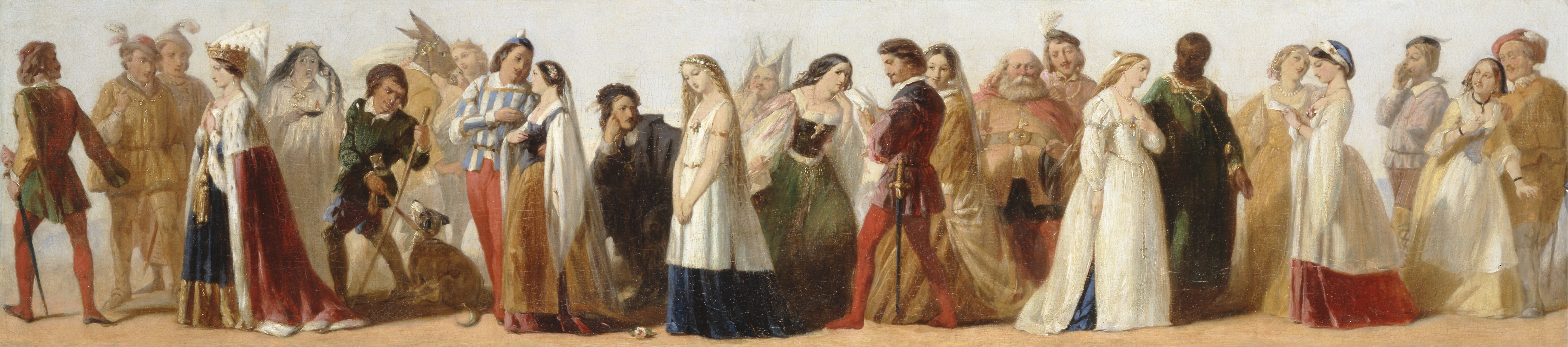 |
Assorted Shakespeare characters. Public domain image from Wikipedia.
|
The preceding notices may fairly authorize us to infer that the ancient play of Hamlet--1. Was written by either an attorney or an attorney's clerk, who had not received a university education; 2. Was full of tragical, high-sounding speeches; 3. Contained the passage "There are things called whips in store," spoken by Hamlet; 4. Included a very telling brief speech by the Ghost in the two words "Hamlet, revenge!" 5. Was acted at the theatre in Shoreditch and at the playhouse at Newington Butts; 6. Had for its principal character a hero exhibiting more general violence than can be attributed to Shakespeare's creation of Hamlet.
Sunday, April 19, 2015
Shakespeare’s Masterpiece, Hamlet
Featuring an excerpt from an unfinished work by James Halliwell-Phillipps written before his death in 1889.
Introduction to our series Hamlet, Drama’s Apex:
The tragedy of Hamlet is generally regarded by critics as Shakespeare's masterpiece. Hence it is often referred to as the highest literary product of human genius. In the following discussion of the play, Mr. J. O. Halliwell-Phillipps, the master and dean of later Shakespearean scholars, gives 1601 as the probable date of its first production. At that time Shakespeare was a London actor, and leading shareholder in the Globe Theatre, where his play was presumably produced. He had made his first big success some five years before with Romeo and Juliet, and was, so far as we can judge, on the high tide of financial prosperity. The profession of an actor carried with it in those days much discredit, but in his far-off home at Stratford, Shakespeare had in 1601 already begun to seek the repute of a country gentleman, and had purchased the finest house and estate in the little village. And now, James Halliwell-Phillipps
Time: 1601
Place: London, Globe Theater
The tragedy of Hamlet is unquestionably the highest effort of artistic literary power yet given to the world. There is nothing to be found in real competition with it excepting in the other works of Shakespeare, but all are inferior to this great masterpiece. There is hardly a speech in the whole play which may not fairly be made the subject of an elaborate discourse, especially when viewed in connection with its bearings, however occasionally remote, on the character of Hamlet, the development of which appears to have been the chief object of the author, not only in the management of the plot, but in the creation of the other personages who are introduced. There is contemporary evidence to this effect in the Stationers' Register of 1602 in the title there given--The Revenge of Hamlet.
There was an old English tragedy on the subject of Hamlet which was in existence at least as early as the year 1589, in the representation of which an exclamation of the Ghost--"Hamlet, revenge!"--was a striking and well-remembered feature. This production is alluded to in some prefatory matter by Nash in the edition of Greene's Menaphon, issued in that year, here given: "I'le turne backe to my first text, of studies of delight, and talke a little in friendship with a few of our triuiall translators. It is a common practise now a daies amongst a sort of shifting companions that run through euery arte and thriue by none, to leaue the trade of Nouerint whereto they were borne, and busie themselues with the indeuors of art, that could scarcelie latinize their necke-verse if they should haue neede; yet English Seneca read by candle light yeeldes manie good sentences, as Bloud is a beggar, and so foorth: and if you intreate him faire in a frostie morning, he will afoord you whole Hamlets, I should say hand-fulls of tragical speeches."
Introduction to our series Hamlet, Drama’s Apex:
The tragedy of Hamlet is generally regarded by critics as Shakespeare's masterpiece. Hence it is often referred to as the highest literary product of human genius. In the following discussion of the play, Mr. J. O. Halliwell-Phillipps, the master and dean of later Shakespearean scholars, gives 1601 as the probable date of its first production. At that time Shakespeare was a London actor, and leading shareholder in the Globe Theatre, where his play was presumably produced. He had made his first big success some five years before with Romeo and Juliet, and was, so far as we can judge, on the high tide of financial prosperity. The profession of an actor carried with it in those days much discredit, but in his far-off home at Stratford, Shakespeare had in 1601 already begun to seek the repute of a country gentleman, and had purchased the finest house and estate in the little village. And now, James Halliwell-Phillipps
Time: 1601
Place: London, Globe Theater
|
Assorted Shakespeare characters. Public domain image from Wikipedia.
|
There was an old English tragedy on the subject of Hamlet which was in existence at least as early as the year 1589, in the representation of which an exclamation of the Ghost--"Hamlet, revenge!"--was a striking and well-remembered feature. This production is alluded to in some prefatory matter by Nash in the edition of Greene's Menaphon, issued in that year, here given: "I'le turne backe to my first text, of studies of delight, and talke a little in friendship with a few of our triuiall translators. It is a common practise now a daies amongst a sort of shifting companions that run through euery arte and thriue by none, to leaue the trade of Nouerint whereto they were borne, and busie themselues with the indeuors of art, that could scarcelie latinize their necke-verse if they should haue neede; yet English Seneca read by candle light yeeldes manie good sentences, as Bloud is a beggar, and so foorth: and if you intreate him faire in a frostie morning, he will afoord you whole Hamlets, I should say hand-fulls of tragical speeches."
Saturday, April 18, 2015
The History Behind Netanhayu's Big Speech to Congress
 |
Israeli Prime Minister Benjamin Netanhayu Meets with
U.S.
Secretary of State John Kerry,
Public domain image from Wikipedia.
|
Benjamin Netanhayu's March 3 speech to a joint session of the U.S. Congress was controversial but in line with a long list of precedents going back to Marquis de Lafayette in 1824. This article puts the event in its historical context. What matters most, the diplomatic decorum of a such a speech or its substantive importance?
Thursday, April 16, 2015
From the Early Days of Baseball
Time: July 31, 1915
Place: The Offices of The Saturday Evening Post
Ring Lardner’s most famous story, Alabi Ike is published. Today we print the first part of the story. The YouTube is a radio show. This show from 1937 was based upon the whole thing.
His right name was Frank X. Farrell, and I guess the X stood for "Excuse me." Because he never pulled a play, good or bad, on or off the field, without apologizin' for it.
"Alibi Ike" was the name Carey wished on him the first day he reported down South. O' course we all cut out the "Alibi" part of it right away for the fear he would overhear it and bust somebody. But we called him "Ike" right to his face and the rest of it was understood by everybody on the club except Ike himself.
Place: The Offices of The Saturday Evening Post
Ring Lardner’s most famous story, Alabi Ike is published. Today we print the first part of the story. The YouTube is a radio show. This show from 1937 was based upon the whole thing.
Radio version of the story.
His right name was Frank X. Farrell, and I guess the X stood for "Excuse me." Because he never pulled a play, good or bad, on or off the field, without apologizin' for it.
"Alibi Ike" was the name Carey wished on him the first day he reported down South. O' course we all cut out the "Alibi" part of it right away for the fear he would overhear it and bust somebody. But we called him "Ike" right to his face and the rest of it was understood by everybody on the club except Ike himself.
Wednesday, April 15, 2015
Income Tax Day 2015
 |
| Page 4 of the return showing the income tax rates for 1862. Public domain form from the Tax History Project. |
The first income tax was adopted and signed by President Abraham Lincoln in 1862 as a war measure. This links to the complete income tax package for that year. Forms, instructions, and tax tables brought the entire package to four (!) pages.
There were two basic rates: 3% of those whose incomes were <$10,000 and 5% for incomes >$10,000. Interest from government bonds were taxed at 1.5%. The instructions' explained a standard deduction of $600 by saying that this was the average expenses of a family in 1862.
After years of court rulings and constitutional amendments, this little seedling grew into the monster tax package Americans struggle with today.
Tuesday, April 14, 2015
What Pontus Says About the Scythians
Previously in Herodotus
7. Thus the Scythians say they were produced; and from the time of their origin, that is to say from the first king Targitaos, to the passing over of Darius against them, they say that there is a period of a thousand years and no more. Now this sacred gold is guarded by the kings with the utmost care, and they visit it every year with solemn sacrifices of propitiation: moreover if any one goes to sleep while watching in the open air over this gold during the festival, the Scythians say that he does not live out the year; and there is given him for this so much land as he shall ride round himself on his horse in one day. Now as the land was large, Colaxaïs, they say, established three kingdoms for his sons; and of these he made one larger than the rest, and in this the gold is kept. But as to the upper parts which lie on the North side of those who dwell above this land, they say one can neither see nor pass through any further by reason of feathers which are poured down; for both the earth and the air are full of feathers, and this is that which shuts off the view.
7. Thus the Scythians say they were produced; and from the time of their origin, that is to say from the first king Targitaos, to the passing over of Darius against them, they say that there is a period of a thousand years and no more. Now this sacred gold is guarded by the kings with the utmost care, and they visit it every year with solemn sacrifices of propitiation: moreover if any one goes to sleep while watching in the open air over this gold during the festival, the Scythians say that he does not live out the year; and there is given him for this so much land as he shall ride round himself on his horse in one day. Now as the land was large, Colaxaïs, they say, established three kingdoms for his sons; and of these he made one larger than the rest, and in this the gold is kept. But as to the upper parts which lie on the North side of those who dwell above this land, they say one can neither see nor pass through any further by reason of feathers which are poured down; for both the earth and the air are full of feathers, and this is that which shuts off the view.
Monday, April 13, 2015
Thus Dies Antony and Cleopatra
Featuring Henry George Liddell from his book A History of Rome from 1855.
Previously on Death of Antony and Cleopatra. And now Henry George Liddell.
Time: August 30 BC
Place: Alexandria, Egypt
When Antony and Cleopatra arrived off Alexandria they put a bold face upon the matter. Some time passed before the real state of the case was known; but it soon became plain that Egypt was at the mercy of the conqueror. The Queen formed all kinds of wild designs. One was to transport the ships that she had saved across the Isthmus of Suez and seek refuge in some distant land where the name of Rome was yet unknown. Some ships were actually drawn across, but they were destroyed by the Arabs, and the plan was abandoned. She now flattered herself that her powers of fascination, proved so potent over Caesar and Antony, might subdue Octavian. Secret messages passed between the conqueror and the Queen; nor were Octavian's answers such as to banish hope.
Antony, full of repentance and despair, shut himself up in Pharos, and there remained in gloomy isolation.
Previously on Death of Antony and Cleopatra. And now Henry George Liddell.
Time: August 30 BC
Place: Alexandria, Egypt
When Antony and Cleopatra arrived off Alexandria they put a bold face upon the matter. Some time passed before the real state of the case was known; but it soon became plain that Egypt was at the mercy of the conqueror. The Queen formed all kinds of wild designs. One was to transport the ships that she had saved across the Isthmus of Suez and seek refuge in some distant land where the name of Rome was yet unknown. Some ships were actually drawn across, but they were destroyed by the Arabs, and the plan was abandoned. She now flattered herself that her powers of fascination, proved so potent over Caesar and Antony, might subdue Octavian. Secret messages passed between the conqueror and the Queen; nor were Octavian's answers such as to banish hope.
Antony, full of repentance and despair, shut himself up in Pharos, and there remained in gloomy isolation.
Sunday, April 12, 2015
Battle of Actium
Featuring Henry George Liddell from his book A History of Rome from 1855.
Previously on Death of Antony and Cleopatra. And now Henry George Liddell.
Time: August 30 BC
Place: Alexandria, Egypt
In point of fidelity to his marriage vows Octavian was little better than Antony. He renounced his marriage with Clodia, the daughter of Fulvia, when her mother attempted to raise Italy against him. He divorced Scribonia, when it no longer suited him to court the favor of her kinsman. To replace this second wife, he forcibly took away Livia from her husband, T. Claudius Nero, though she was at that time pregnant of her second son. But in this and other less pardonable immoralities there was nothing to shock the feelings of Romans.
But Octavian never suffered pleasure to divert him from business. If he could not be a successful general, he resolved at least to show that he could be a hardy soldier. While Antony in his Egyptian palace was neglecting the Parthian War, his rival led his legions in more than one dangerous campaign against the barbarous Dalmatians and Pannonians, who had been for some time infesting the province of Illyricum. In the year B.C. 33 he announced that the limits of the empire had been extended northward to the banks of the Save.
Previously on Death of Antony and Cleopatra. And now Henry George Liddell.
Time: August 30 BC
Place: Alexandria, Egypt
In point of fidelity to his marriage vows Octavian was little better than Antony. He renounced his marriage with Clodia, the daughter of Fulvia, when her mother attempted to raise Italy against him. He divorced Scribonia, when it no longer suited him to court the favor of her kinsman. To replace this second wife, he forcibly took away Livia from her husband, T. Claudius Nero, though she was at that time pregnant of her second son. But in this and other less pardonable immoralities there was nothing to shock the feelings of Romans.
But Octavian never suffered pleasure to divert him from business. If he could not be a successful general, he resolved at least to show that he could be a hardy soldier. While Antony in his Egyptian palace was neglecting the Parthian War, his rival led his legions in more than one dangerous campaign against the barbarous Dalmatians and Pannonians, who had been for some time infesting the province of Illyricum. In the year B.C. 33 he announced that the limits of the empire had been extended northward to the banks of the Save.
Saturday, April 11, 2015
The American Cowboy
Here is a documentary about the legendary cowboys of the old west in America. It was uploaded just 36 days ago.
From the latest happenings in things historical.
From the latest happenings in things historical.
Friday, April 10, 2015
Again: Birth of a Nation Rocks America
This film taught America 4 things: (1) people would line up for blocks to see a movie; (2) there was a civil rights movement in America with an organization called The NAACP; (3) film makers could make lots of money; and (4) D.W. Griffin was the greatest film maker in the world.
Every so often we like to resurrect an article from the blog’s past. This one is from December 9, 2008. – Just one of the gems buried in the blog’s archives.
QUOTE:Here’s the rest of the article. The original article was written by JL, too.
This is a trailer to the famous movie that created Hollywood - the first full-length movie in American history.
An updated link to the full movie.
Thursday, April 9, 2015
Give the Bible as History the Benefit of the Doubt
 In its outlines, and barring supernatural incidents, the story of the Jews as unfolded in the Old Testament has stood the test of criticism and archeology; every year adds corroboration from documents, monuments, or excavations... We must accept the Biblical account provisionally until it is disproved.
 - Will Durant
More on Will Durant.
Wednesday, April 8, 2015
Antony Chooses Cleopatra; Deserts Wife
Featuring Henry George Liddell from his book A History of Rome from 1855.
Previously on Death of Antony and Cleopatra. And now Henry George Liddell.
Time: August 30 BC
Place: Alexandria, Egypt
Off Mylae, a place famous for having witnessed the first naval victory of the Romans, Agrippa encountered the fleet of Sext Pompeius; but Sextus, with the larger portion of his ships, gave Agrippa the slip, and sailing eastward fell suddenly upon Octavian's squadron off Tauromenium. A desperate conflict followed, which ended in the complete triumph of Sextus, and Octavian escaped to Italy with a few ships only. But Agrippa was soon upon the traces of the enemy. On the 3d of September Sextus was obliged once more to accept battle near the Straits of Messana, and suffered an irretrievable defeat. His troops on land were attacked and dispersed by an army which had been landed on the eastern coast by the indefatigable Octavian; and Sextus sailed off to Lesbos, where he had found refuge as a boy during the campaign of Pharsalia, to seek protection from the jealousy of Antony.
Lepidus had assisted in the campaign; but after the departure of Sextus he openly declared himself independent of his brother triumvirs. Octavian, with prompt and prudent boldness, entered the camp of Lepidus in person with a few attendants. The soldiers deserted in crowds, and in a few hours Lepidus was fain to sue for pardon, where he had hoped to rule. He was treated with contemptuous indifference, Africa was taken from him; but he was allowed to live and die at Rome in quiet enjoyment of the chief pontificate.
Previously on Death of Antony and Cleopatra. And now Henry George Liddell.
Time: August 30 BC
Place: Alexandria, Egypt
Off Mylae, a place famous for having witnessed the first naval victory of the Romans, Agrippa encountered the fleet of Sext Pompeius; but Sextus, with the larger portion of his ships, gave Agrippa the slip, and sailing eastward fell suddenly upon Octavian's squadron off Tauromenium. A desperate conflict followed, which ended in the complete triumph of Sextus, and Octavian escaped to Italy with a few ships only. But Agrippa was soon upon the traces of the enemy. On the 3d of September Sextus was obliged once more to accept battle near the Straits of Messana, and suffered an irretrievable defeat. His troops on land were attacked and dispersed by an army which had been landed on the eastern coast by the indefatigable Octavian; and Sextus sailed off to Lesbos, where he had found refuge as a boy during the campaign of Pharsalia, to seek protection from the jealousy of Antony.
Lepidus had assisted in the campaign; but after the departure of Sextus he openly declared himself independent of his brother triumvirs. Octavian, with prompt and prudent boldness, entered the camp of Lepidus in person with a few attendants. The soldiers deserted in crowds, and in a few hours Lepidus was fain to sue for pardon, where he had hoped to rule. He was treated with contemptuous indifference, Africa was taken from him; but he was allowed to live and die at Rome in quiet enjoyment of the chief pontificate.
Tuesday, April 7, 2015
Persia Attacks Scythia
Previously in Herodotus
Today we begin Book IV.
1. After Babylon had been taken, the march of Darius himself against the Scythians took place: for now that Asia was flourishing in respect of population, and large sums were being gathered in as revenue, Darius formed the desire to take vengeance upon the Scythians, because they had first invaded the Median land and had overcome in fight those who opposed them; and thus they had been the beginners of wrong. The Scythians in truth, as I have before said, had ruled over Upper Asia for eight-and-twenty years; for they had invaded Asia in their pursuit of the Kimmerians, and they had deposed the Medes from their rule, who had rule over Asia before the Scythians came. Now when the Scythians had been absent from their own land for eight-and-twenty years, as they were returning to it after that interval of time, they were met by a contest not less severe than that which they had had with the Medes, since they found an army of no mean size opposing them. For the wives of the Scythians, because their husbands were absent from them for a long time, had associated with the slaves.
Today we begin Book IV.
1. After Babylon had been taken, the march of Darius himself against the Scythians took place: for now that Asia was flourishing in respect of population, and large sums were being gathered in as revenue, Darius formed the desire to take vengeance upon the Scythians, because they had first invaded the Median land and had overcome in fight those who opposed them; and thus they had been the beginners of wrong. The Scythians in truth, as I have before said, had ruled over Upper Asia for eight-and-twenty years; for they had invaded Asia in their pursuit of the Kimmerians, and they had deposed the Medes from their rule, who had rule over Asia before the Scythians came. Now when the Scythians had been absent from their own land for eight-and-twenty years, as they were returning to it after that interval of time, they were met by a contest not less severe than that which they had had with the Medes, since they found an army of no mean size opposing them. For the wives of the Scythians, because their husbands were absent from them for a long time, had associated with the slaves.
Monday, April 6, 2015
Octavian Consolidates His Rule
Featuring Henry George Liddell from his book A History of Rome from 1855.
Previously on Death of Antony and Cleopatra. And now Henry George Liddell.
Time: August 30 BC
Place: Alexandria, Egypt
Antony and Octavian renewed their professions of amity, and entered Rome together in joint ovation to celebrate the restoration of peace. They now made a third division of the provinces, by which Scodra (Scutari) in Illyricum was fixed as the boundary of the West and East; Lepidus was still left in possession of Africa. It was further agreed that Octavian was to drive Sext Pompeius, lately the ally of Antony, out of Sicily; while Antony renewed his pledges to recover the standards of Crassus from the Parthians. The new compact was sealed by the marriage of Antony with Octavia, his colleague's sister, a virtuous and beautiful lady, worthy of a better consort. These auspicious events were celebrated by the lofty verse of Vergil's Fourth Eclogue.
Previously on Death of Antony and Cleopatra. And now Henry George Liddell.
Time: August 30 BC
Place: Alexandria, Egypt
Antony and Octavian renewed their professions of amity, and entered Rome together in joint ovation to celebrate the restoration of peace. They now made a third division of the provinces, by which Scodra (Scutari) in Illyricum was fixed as the boundary of the West and East; Lepidus was still left in possession of Africa. It was further agreed that Octavian was to drive Sext Pompeius, lately the ally of Antony, out of Sicily; while Antony renewed his pledges to recover the standards of Crassus from the Parthians. The new compact was sealed by the marriage of Antony with Octavia, his colleague's sister, a virtuous and beautiful lady, worthy of a better consort. These auspicious events were celebrated by the lofty verse of Vergil's Fourth Eclogue.
Saturday, April 4, 2015
Napoleonic Grand Strategy
This article from just 5 days ago looks at power: how it is acquired and how it is used. The professor is interested in how Napoleon came from nowhere to become master of most of Europe.
Thursday, April 2, 2015
April to May to ?
 |
CC BY-SA 3.0 image from Wikipedia.
|
Answer: Pilgrims
Tuesday, March 31, 2015
Darius Conquers Babylon Again
Previously in Herodotus
Today Book III ends. Next week begins Book IV.
158. But when Darius made an attack according to the agreement on every side of the wall, then Zopyros discovered all his craft: for while the Babylonians, having gone up on the wall, were defending themselves against the attacks of the army of Darius, Zopyros opened the gates called the gates of Kissia and of Belos, and let in the Persians within the wall. And of the Babylonians those who saw that which was done fled to the temple of Zeus Belos, but those who did not see remained each in his own appointed place, until at last they also learnt that they had been betrayed.
Today Book III ends. Next week begins Book IV.
158. But when Darius made an attack according to the agreement on every side of the wall, then Zopyros discovered all his craft: for while the Babylonians, having gone up on the wall, were defending themselves against the attacks of the army of Darius, Zopyros opened the gates called the gates of Kissia and of Belos, and let in the Persians within the wall. And of the Babylonians those who saw that which was done fled to the temple of Zeus Belos, but those who did not see remained each in his own appointed place, until at last they also learnt that they had been betrayed.
Monday, March 30, 2015
Octavian Needs Money
Featuring Henry George Liddell from his book A History of Rome from 1855.
Previously on Death of Antony and Cleopatra. And now Henry George Liddell.
Time: August 30 BC
Place: Alexandria, Egypt
The battle of Philippi was in reality the closing scene of the republican drama. But the rivalship of the triumvirs prolonged for several years the divided state of the Roman world; and it was not till after the crowning victory of Actium that the imperial government was established in its unity. We shall, therefore, here add a rapid narrative of the events which led to that consummation.
The hopeless state of the republican or rather the senatorial party was such that almost all hastened to make submission to the conquerors: those whose sturdy spirit still disdained submission resorted to Sext Pompeius in Sicily. Octavian, still suffering from ill-health, was anxious to return to Italy; but before he parted from Antony, they agreed to a second distribution of the provinces of the empire. Antony was to have the Eastern world; Octavian the Western provinces. To Lepidus, who was not consulted in this second division, Africa alone was left. Sext Pompeius remained in possession of Sicily.
Previously on Death of Antony and Cleopatra. And now Henry George Liddell.
Time: August 30 BC
Place: Alexandria, Egypt
The battle of Philippi was in reality the closing scene of the republican drama. But the rivalship of the triumvirs prolonged for several years the divided state of the Roman world; and it was not till after the crowning victory of Actium that the imperial government was established in its unity. We shall, therefore, here add a rapid narrative of the events which led to that consummation.
The hopeless state of the republican or rather the senatorial party was such that almost all hastened to make submission to the conquerors: those whose sturdy spirit still disdained submission resorted to Sext Pompeius in Sicily. Octavian, still suffering from ill-health, was anxious to return to Italy; but before he parted from Antony, they agreed to a second distribution of the provinces of the empire. Antony was to have the Eastern world; Octavian the Western provinces. To Lepidus, who was not consulted in this second division, Africa alone was left. Sext Pompeius remained in possession of Sicily.
Sunday, March 29, 2015
Destiny at Philippi
Featuring Henry George Liddell from his book A History of Rome from 1855.
Previously on Death of Antony and Cleopatra. And now Henry George Liddell.
Time: August 30 BC
Place: Alexandria, Egypt
Meantime Antony's lieutenants had crossed the Ionian Sea and penetrated without opposition into Thrace. The republican leaders found them at Philippi. The army of Brutus and Cassius amounted to at least eighty thousand infantry, supported by twenty thousand horse; but they were ill-supplied with experienced officers. For M. Valerius Messalla, a young man of twenty-eight, held the chief command after Brutus and Cassius; and Horace, who was but three-and-twenty, the son of a freedman, and a youth of feeble constitution, was appointed a legionary tribune. The forces opposed to them would have been at once overpowered had not Antony himself opportunely arrived with the second corps of the triumviral army. Octavian was detained by illness at Dyrrhachium, but he ordered himself to be carried on a litter to join his legions. The army of the triumvirs was now superior to the enemy; but their cavalry, counting only thirteen thousand, was considerably weaker than the force opposed to it. The republicans were strongly posted upon two hills, with intrenchments between: the camp of Cassius upon the left next the sea, that of Brutus inland on the right. The triumviral army lay upon the open plain before them, in a position rendered unhealthy by marshes; Antony, on the right, was opposed to Cassius; Octavian, on the left, fronted Brutus. But they were ill-supplied with provisions and anxious for a decisive battle. The republicans, however, kept to their intrenchments, and the other party began to suffer severely from famine.
Previously on Death of Antony and Cleopatra. And now Henry George Liddell.
Time: August 30 BC
Place: Alexandria, Egypt
Meantime Antony's lieutenants had crossed the Ionian Sea and penetrated without opposition into Thrace. The republican leaders found them at Philippi. The army of Brutus and Cassius amounted to at least eighty thousand infantry, supported by twenty thousand horse; but they were ill-supplied with experienced officers. For M. Valerius Messalla, a young man of twenty-eight, held the chief command after Brutus and Cassius; and Horace, who was but three-and-twenty, the son of a freedman, and a youth of feeble constitution, was appointed a legionary tribune. The forces opposed to them would have been at once overpowered had not Antony himself opportunely arrived with the second corps of the triumviral army. Octavian was detained by illness at Dyrrhachium, but he ordered himself to be carried on a litter to join his legions. The army of the triumvirs was now superior to the enemy; but their cavalry, counting only thirteen thousand, was considerably weaker than the force opposed to it. The republicans were strongly posted upon two hills, with intrenchments between: the camp of Cassius upon the left next the sea, that of Brutus inland on the right. The triumviral army lay upon the open plain before them, in a position rendered unhealthy by marshes; Antony, on the right, was opposed to Cassius; Octavian, on the left, fronted Brutus. But they were ill-supplied with provisions and anxious for a decisive battle. The republicans, however, kept to their intrenchments, and the other party began to suffer severely from famine.
Saturday, March 28, 2015
A Gallery of Turner Paintings
From the latest happenings in things historical. JMW Turner – The Complete Works
 |
| Arundel Castle, 1824
CC BY-SA 3.0 image from william-turner.org.
|
Look this site up and spend hours in the gallery.
Thursday, March 26, 2015
The Price of Greatness

Wednesday, March 25, 2015
Death Follows Caesar’s Murderers
Featuring Henry George Liddell from his book A History of Rome from 1855.
Previously on Death of Antony and Cleopatra. And now Henry George Liddell.
Time: August 30 BC
Place: Alexandria, Egypt
As soon as their secret business was ended, the triumvirs determined to enter Rome publicly. Hitherto they had not published more than seventeen names of the proscribed. They made their entrance severally on three successive days, each attended by a legion. A law was immediately brought in to invest them formally with the supreme authority, which they had assumed. This was followed by the promulgation of successive lists, each larger than its predecessor.
Among the victims, far the most conspicuous was Cicero. With his brother Quintus, the old orator had retired to his Tusculan villa after the battle of Mutina; and now they endeavored to escape in the hope of joining Brutus in Macedonia; for the orator's only son was serving as a tribune in the liberator's army. After many changes of domicile they reached Astura, a little island near Antium, where they found themselves short of money, and Quintus ventured to Rome to procure the necessary supply. Here he was recognized and seized, together with his son. Each desired to die first, and the mournful claim to precedence was settled by the soldiers killing both at the same moment.
Previously on Death of Antony and Cleopatra. And now Henry George Liddell.
Time: August 30 BC
Place: Alexandria, Egypt
As soon as their secret business was ended, the triumvirs determined to enter Rome publicly. Hitherto they had not published more than seventeen names of the proscribed. They made their entrance severally on three successive days, each attended by a legion. A law was immediately brought in to invest them formally with the supreme authority, which they had assumed. This was followed by the promulgation of successive lists, each larger than its predecessor.
Among the victims, far the most conspicuous was Cicero. With his brother Quintus, the old orator had retired to his Tusculan villa after the battle of Mutina; and now they endeavored to escape in the hope of joining Brutus in Macedonia; for the orator's only son was serving as a tribune in the liberator's army. After many changes of domicile they reached Astura, a little island near Antium, where they found themselves short of money, and Quintus ventured to Rome to procure the necessary supply. Here he was recognized and seized, together with his son. Each desired to die first, and the mournful claim to precedence was settled by the soldiers killing both at the same moment.
Tuesday, March 24, 2015
Babylon Attacks the Persians
Previously in Herodotus
155. And Darius was exceedingly troubled when he saw the man of most repute with him thus maltreated; and leaping up from his seat he cried aloud and asked him who was the person who had maltreated him, and for what deed. He replied: "That man does not exist, excepting thee, who has so great power as to bring me into this condition; and not any stranger, O king, has done this, but I myself to myself, accounting it a very grievous thing that the Assyrians should make a mock of the Persians." He made answer: "Thou most reckless of men, thou didst set the fairest name to the foulest deed when thou saidest that on account of those who are besieged thou didst bring thyself into a condition which cannot be cured. How, O thou senseless one, will the enemy surrender to us more quickly, because thou hast maltreated thyself? Surely thou didst wander out of thy senses in thus destroying thyself." And he said, "If I had communicated to thee that which I was about to do, thou wouldst not have permitted me to do it; but as it was, I did it on my own account. Now therefore, unless something is wanting on thy part, we shall conquer Babylon: for I shall go straightway as a deserter to the wall; and I shall say to them that I suffered this treatment at thy hands: and I think that when I have convinced them that this is so, I shall obtain the command of a part of their forces. Do thou then on the tenth day from that on which I shall enter within the wall take of those troops about which thou wilt have no concern if they be destroyed,—of these, I say, get a thousand by the gate of the city which is called the gate of Semiramis; and after this again on the seventh day after the tenth set, I pray thee, two thousand by the gate which is called the gate of the Ninevites; and after this seventh day let twenty days elapse, and then lead other four thousand and place them by the gate called the gate of the Chaldeans: and let neither the former men nor these have any weapons to defend them except daggers, but this weapon let them have. Then after the twentieth day at once bid the rest of the army make an attack on the wall all round, and set the Persians, I pray thee, by those gates which are called the gate of Belos and the gate of Kissia: for, as I think, when I have displayed great deeds of prowess, the Babylonians will entrust to me, besides their other things, also the keys which draw the bolts of the gates. Then after that it shall be the care of myself and the Persians to do that which ought to be done."
156. Having thus enjoined he proceeded to go to the gate of the city, turning to look behind him as he went, as if he were in truth a deserter; and those who were set in that part of the wall, seeing him from the towers ran down, and slightly opening one wing of the gate asked who he was, and for what purpose he had come. And he addressed them and said that he was Zopyros, and that he came as a deserter to them. The gate-keepers accordingly when they heard this led him to the public assembly of the Babylonians; and being introduced before it he began to lament his fortunes, saying that he had in fact suffered at his own hands, and that he had suffered this because he had counseled the king to withdraw his army, since in truth there seemed to be no means of taking the town: "And now," he went on to say, "I am come for very great good to you, O Babylonians, but for very great evil to Darius and his army, and to the Persians, for he shall surely not escape with impunity for having thus maltreated me; and I know all the courses of his counsels."
157. Thus he spoke, and the Babylonians, when they saw the man of most reputation among the Persians deprived of nose and ears and smeared over with blood from scourging, supposing assuredly that he was speaking the truth and had come to be their helper, were ready to put in his power that for which he asked them, and he asked them that he might command a certain force. Then when he had obtained this from them, he did that which he had agreed with Darius that he would do; for he led out on the tenth day the army of the Babylonians, and having surrounded the thousand men whom he had enjoined Darius first to set there, he slew them. The Babylonians accordingly, perceiving that the deeds which he displayed were in accordance with his words, were very greatly rejoiced and were ready to serve him in all things: and after the lapse of the days which had been agreed upon, he again chose men of the Babylonians and led them out and slew the two thousand men of the troops of Darius. Seeing this deed also, the Babylonians all had the name of Zopyros upon their tongues, and were loud in his praise. He then again, after the lapse of the days which had been agreed upon, led them out to the place appointed, and surrounded the four thousand and slew them. When this also had been done, Zopyros was everything among the Babylonians, and he was appointed both commander of their army and guardian of their walls.
- Herodotus, Book III
More Information: from the New Yorker Magazine, Herodotus's Book.
155. And Darius was exceedingly troubled when he saw the man of most repute with him thus maltreated; and leaping up from his seat he cried aloud and asked him who was the person who had maltreated him, and for what deed. He replied: "That man does not exist, excepting thee, who has so great power as to bring me into this condition; and not any stranger, O king, has done this, but I myself to myself, accounting it a very grievous thing that the Assyrians should make a mock of the Persians." He made answer: "Thou most reckless of men, thou didst set the fairest name to the foulest deed when thou saidest that on account of those who are besieged thou didst bring thyself into a condition which cannot be cured. How, O thou senseless one, will the enemy surrender to us more quickly, because thou hast maltreated thyself? Surely thou didst wander out of thy senses in thus destroying thyself." And he said, "If I had communicated to thee that which I was about to do, thou wouldst not have permitted me to do it; but as it was, I did it on my own account. Now therefore, unless something is wanting on thy part, we shall conquer Babylon: for I shall go straightway as a deserter to the wall; and I shall say to them that I suffered this treatment at thy hands: and I think that when I have convinced them that this is so, I shall obtain the command of a part of their forces. Do thou then on the tenth day from that on which I shall enter within the wall take of those troops about which thou wilt have no concern if they be destroyed,—of these, I say, get a thousand by the gate of the city which is called the gate of Semiramis; and after this again on the seventh day after the tenth set, I pray thee, two thousand by the gate which is called the gate of the Ninevites; and after this seventh day let twenty days elapse, and then lead other four thousand and place them by the gate called the gate of the Chaldeans: and let neither the former men nor these have any weapons to defend them except daggers, but this weapon let them have. Then after the twentieth day at once bid the rest of the army make an attack on the wall all round, and set the Persians, I pray thee, by those gates which are called the gate of Belos and the gate of Kissia: for, as I think, when I have displayed great deeds of prowess, the Babylonians will entrust to me, besides their other things, also the keys which draw the bolts of the gates. Then after that it shall be the care of myself and the Persians to do that which ought to be done."
156. Having thus enjoined he proceeded to go to the gate of the city, turning to look behind him as he went, as if he were in truth a deserter; and those who were set in that part of the wall, seeing him from the towers ran down, and slightly opening one wing of the gate asked who he was, and for what purpose he had come. And he addressed them and said that he was Zopyros, and that he came as a deserter to them. The gate-keepers accordingly when they heard this led him to the public assembly of the Babylonians; and being introduced before it he began to lament his fortunes, saying that he had in fact suffered at his own hands, and that he had suffered this because he had counseled the king to withdraw his army, since in truth there seemed to be no means of taking the town: "And now," he went on to say, "I am come for very great good to you, O Babylonians, but for very great evil to Darius and his army, and to the Persians, for he shall surely not escape with impunity for having thus maltreated me; and I know all the courses of his counsels."
157. Thus he spoke, and the Babylonians, when they saw the man of most reputation among the Persians deprived of nose and ears and smeared over with blood from scourging, supposing assuredly that he was speaking the truth and had come to be their helper, were ready to put in his power that for which he asked them, and he asked them that he might command a certain force. Then when he had obtained this from them, he did that which he had agreed with Darius that he would do; for he led out on the tenth day the army of the Babylonians, and having surrounded the thousand men whom he had enjoined Darius first to set there, he slew them. The Babylonians accordingly, perceiving that the deeds which he displayed were in accordance with his words, were very greatly rejoiced and were ready to serve him in all things: and after the lapse of the days which had been agreed upon, he again chose men of the Babylonians and led them out and slew the two thousand men of the troops of Darius. Seeing this deed also, the Babylonians all had the name of Zopyros upon their tongues, and were loud in his praise. He then again, after the lapse of the days which had been agreed upon, led them out to the place appointed, and surrounded the four thousand and slew them. When this also had been done, Zopyros was everything among the Babylonians, and he was appointed both commander of their army and guardian of their walls.
- Herodotus, Book III
More Information: from the New Yorker Magazine, Herodotus's Book.
Monday, March 23, 2015
Octavius Deserts Cicero and Joins Antony
Featuring Henry George Liddell from his book A History of Rome from 1855.
Previously on Death of Antony and Cleopatra. And now Henry George Liddell.
Time: August 30 BC
Place: Alexandria, Egypt
After his defeat Antony felt it impossible to maintain the siege of Mutina. With Dec. Brutus in the town behind him, and the victorious legions of Octavius before him, his position was critical. He therefore prepared to retreat, and effected this purpose like a good soldier. His destination was the province of Narbonnese Gaul, where Lepidus had assumed the government and had promised him support. But the senate also had hopes in the same quarter. L. Munatius Plancus commanded in Northern Gaul, and C. Asinius Pollio in Southern Spain. Sext Pompeius had made good his ground in the latter country, and had almost expelled Pollio from Baetica. Plancus and Pollio, both friends and favorites of Caesar, had as yet declared neither for Antony nor Octavius. If they would declare for the senate, Lepidus, a feeble and fickle man, might desert Antony; or if Octavius would join with Dec. Brutus, and pursue him, Antony might not be able to escape from Italy at all. But these political combinations failed. Plancus and Pollio stood aloof, waiting for the course of events. Dec. Brutus was not strong enough to pursue Antony by himself, and Octavius was unwilling, perhaps unable, to unite the veterans of Caesar with troops commanded by one of Caesar's murderers. And so it happened that Antony effected his retreat across the Alps, but not without extreme hardships, which he bore in common with the meanest soldier. It was at such times that his good qualities always showed themselves, and his gallant endurance of misery endeared him to every man under his command. On his arrival in Narbonnese Gaul he met Lepidus at Forum Julii (Frejus), and here the two commanders agreed on a plan of operations.
Previously on Death of Antony and Cleopatra. And now Henry George Liddell.
Time: August 30 BC
Place: Alexandria, Egypt
After his defeat Antony felt it impossible to maintain the siege of Mutina. With Dec. Brutus in the town behind him, and the victorious legions of Octavius before him, his position was critical. He therefore prepared to retreat, and effected this purpose like a good soldier. His destination was the province of Narbonnese Gaul, where Lepidus had assumed the government and had promised him support. But the senate also had hopes in the same quarter. L. Munatius Plancus commanded in Northern Gaul, and C. Asinius Pollio in Southern Spain. Sext Pompeius had made good his ground in the latter country, and had almost expelled Pollio from Baetica. Plancus and Pollio, both friends and favorites of Caesar, had as yet declared neither for Antony nor Octavius. If they would declare for the senate, Lepidus, a feeble and fickle man, might desert Antony; or if Octavius would join with Dec. Brutus, and pursue him, Antony might not be able to escape from Italy at all. But these political combinations failed. Plancus and Pollio stood aloof, waiting for the course of events. Dec. Brutus was not strong enough to pursue Antony by himself, and Octavius was unwilling, perhaps unable, to unite the veterans of Caesar with troops commanded by one of Caesar's murderers. And so it happened that Antony effected his retreat across the Alps, but not without extreme hardships, which he bore in common with the meanest soldier. It was at such times that his good qualities always showed themselves, and his gallant endurance of misery endeared him to every man under his command. On his arrival in Narbonnese Gaul he met Lepidus at Forum Julii (Frejus), and here the two commanders agreed on a plan of operations.
Sunday, March 22, 2015
Cicero Speaks Against Antony
Featuring Henry George Liddell from his book A History of Rome from 1855.
Previously on Death of Antony and Cleopatra. And now Henry George Liddell.
Time: August 30 BC
Place: Alexandria, Egypt
Meanwhile Antony had been running riot. In possession of Caesar's papers, with no one to check him, he produced ready warrant for every measure which he wished to carry, and pleaded the vote of the senate which confirmed all the acts of Caesar. When he could not produce a genuine paper, he interpolated or forged what was needful.
On the day after Cicero's return (September 1st) there was a meeting of the senate. But the orator did not attend, and Antony threatened to send men to drag him from his house. Next day Cicero was in his place, but now Antony was absent. The orator arose and addressed the senate in what is called his First Philippic. This was a measured attack upon the government and policy of Antony, but personalities were carefully eschewed: the tone of the whole speech, indeed, is such as might be delivered by a leader of opposition in parliament at the present day. But Antony, enraged at his boldness, summoned a meeting for the 19th of September, which Cicero did not think it prudent to attend. He then attacked the absent orator in the strongest language of personal abuse and menace. Cicero sat down and composed his famous Second Philippic, which is written as if it were delivered on the same day, in reply to Antony's invective. At present, however, he contented himself with sending a copy of it to Atticus, enjoining secrecy.
Previously on Death of Antony and Cleopatra. And now Henry George Liddell.
Time: August 30 BC
Place: Alexandria, Egypt
Meanwhile Antony had been running riot. In possession of Caesar's papers, with no one to check him, he produced ready warrant for every measure which he wished to carry, and pleaded the vote of the senate which confirmed all the acts of Caesar. When he could not produce a genuine paper, he interpolated or forged what was needful.
On the day after Cicero's return (September 1st) there was a meeting of the senate. But the orator did not attend, and Antony threatened to send men to drag him from his house. Next day Cicero was in his place, but now Antony was absent. The orator arose and addressed the senate in what is called his First Philippic. This was a measured attack upon the government and policy of Antony, but personalities were carefully eschewed: the tone of the whole speech, indeed, is such as might be delivered by a leader of opposition in parliament at the present day. But Antony, enraged at his boldness, summoned a meeting for the 19th of September, which Cicero did not think it prudent to attend. He then attacked the absent orator in the strongest language of personal abuse and menace. Cicero sat down and composed his famous Second Philippic, which is written as if it were delivered on the same day, in reply to Antony's invective. At present, however, he contented himself with sending a copy of it to Atticus, enjoining secrecy.
Saturday, March 21, 2015
The History Carnival
This is a selection of "best of" blog posts in the
field of history. It has been pumping
out a monthly report for twelve years.
Yes, History Moments have gotten in there a few times over the
years. Every month another blogger takes
his/her turn hosting the Carnival.
That's why it gets its name - each month it travels around from blog to
blog.
Friday, March 20, 2015
The Tombstone Gunfight
Time: October 26, 1881, 3 pm
Place: Tombstone, Arizona
 |
City map
showing site of gunfight in green;
O.K. Corral in yellow.
Public domain image from Wikipedia.
|
Just 30 seconds before, the two groups of men had stood facing one another in the ally off Fremont Street beside C.S. Fly’s Boarding House. Wyatt Earp, Virgil Earp, Morgan Earp, and Doc Holliday stood just 6 to 10 feet from the Clancy Gang, Ike and Billy, the McLaurys, Tom and Frank, and Billy Clairborne. The O.K. Corral was elsewhere (see map).
The Earp brothers had come to town some months earlier, drawn by the riches flowing from the mining in the area. Virgil became town marshal, Wyatt Pima County deputy sheriff. Morgan was deputy city marshal. Cattle rustlers such as the Clanton and the McLaury brothers viewed the Earps as tyrants, especially as the Earps were happy to bend law enforcement in their favor when their saloon and gambling interests were involved.
After the gunfight, the Clanton faction accused the Earp faction of murder. There was a coroner’s jury, a preliminary hearing to a murder trial, and a grand jury hearing (in that order). The outcome of these three proceedings failed to indict the Earps. The remaining Clantons vowed revenge.
On December 14th, Tombstone Mayor John Clum was ambushed but got away. On December 28th. Virgil Earp was shot. He survived but had to have an arm in a sling for the rest of his life. On March 18, 1882 Morgan Earp was shot and killed while playing billiards. Wyatt took Morgan’s body to the Tuscon train station along with his brother James and the wounded Virgil to relocate to California. Wyatt saw one of the gang lying in ambush and killed him. The Tuscon sheriff issued arrest warrants on the Earps for this killing. Wyatt Earp decided that his family and him could get no safety in the law and launched his own campaign against the gang, killing 3 more.
Thus ended the saga of “The Gunfight at the O.K. Corral” which was never at the O.K. Corral.
More information from Wikipedia about the Gunfight and from History.net about the O.K. Corral.
Thursday, March 19, 2015
Red Army Soldier Gets 30 Years
 |
Stalin with
Red Army soldiers.
Public
Domain image from Wikipedia.
|
Sometime in the 1950’s a soldier in the Red Army ran across Red Square in Moscow
Wednesday, March 18, 2015
Antony Seizes Control
Featuring Henry George Liddell from his book A History of Rome from 1855.
Previously on Death of Antony and Cleopatra. And now Henry George Liddell.
Time: August 30 BC
Place: Alexandria, Egypt
Two or three days after this followed the funeral. The body was to be burned, and the ashes deposited in the Campus Martius, near the tomb of his daughter Julia. But it was first brought into the Forum upon a bier inlaid with ivory and covered with rich tapestries, which was carried by men high in rank and office. There Antony, as consul, rose to pronounce the funeral oration. He ran through the chief acts of Caesar's life, recited his will, and then spoke of the death which had rewarded him. To make this more vividly present to the excitable Italians he displayed a waxen image marked with the three-and-twenty wounds, and produced the very robe which he had worn, all rent and blood-stained. Soul-stirring dirges added to the solemn horror of the scene. But to us the memorable speech which Shakespeare puts into Antony's mouth will give the liveliest notion of the art used and the impression produced. That impression was instantaneous. The senator friends of the liberators who had attended the ceremony looked on in moody silence. Soon the menacing gestures of the crowd made them look to their safety. They fled; and the multitude insisted on burning the body, as they had burned the body of Clodius, in the sacred precincts of the Forum. Some of the veterans who attended the funeral set fire to the bier; benches and firewood heaped round it soon made a sufficient pile.
Previously on Death of Antony and Cleopatra. And now Henry George Liddell.
Time: August 30 BC
Place: Alexandria, Egypt
Two or three days after this followed the funeral. The body was to be burned, and the ashes deposited in the Campus Martius, near the tomb of his daughter Julia. But it was first brought into the Forum upon a bier inlaid with ivory and covered with rich tapestries, which was carried by men high in rank and office. There Antony, as consul, rose to pronounce the funeral oration. He ran through the chief acts of Caesar's life, recited his will, and then spoke of the death which had rewarded him. To make this more vividly present to the excitable Italians he displayed a waxen image marked with the three-and-twenty wounds, and produced the very robe which he had worn, all rent and blood-stained. Soul-stirring dirges added to the solemn horror of the scene. But to us the memorable speech which Shakespeare puts into Antony's mouth will give the liveliest notion of the art used and the impression produced. That impression was instantaneous. The senator friends of the liberators who had attended the ceremony looked on in moody silence. Soon the menacing gestures of the crowd made them look to their safety. They fled; and the multitude insisted on burning the body, as they had burned the body of Clodius, in the sacred precincts of the Forum. Some of the veterans who attended the funeral set fire to the bier; benches and firewood heaped round it soon made a sufficient pile.
Tuesday, March 17, 2015
Saint Patrick's Day, 2015
by Jack Le Moine
Time: March 17, 1762
Place: New York City
 |
| Fair use image from a Clip Art collection. |
The Catholic Church had made March 17 a feast day to commemorate Saint Patrick a century before. Since Saint Patrick was the patron saint of Ireland, this day became a civic celebration as well as a religious one for the Irish.
Celebrations would grow all around the world.
Further information: Jerry Wilson, Wilstar.com.
Monday, March 16, 2015
Julius Caesar Dead
Featuring Henry George Liddell from his book A History of Rome from 1855.
Introduction to our series Death of Antony and Cleopatra:
You’ve seen the movies. Maybe you’ve even seen the mini-series. You’ve read Shakespeare’s play. Maybe you’ve even watched a production of it. Or you can listen to it here.
Now read the real story. It is more than just a romantic drama. It is also the story of the end of the Roman Republic and the birth of the Empire.
Henry George Liddell (1811 – 1898) was a professor who rose to be Vice-Chancellor of Oxford University. He wrote the book on ancient Rome. Here’s the authoritative account of this classic and important story. And now, Henry George Liddell.
Time: August 30 BC
Place: Alexandria, Egypt
While the conspirators were at their bloody work [of slaying Caesar], the mass of the senators rushed in confused terror to the doors; and when Brutus turned to address his peers in defense of the deed, the hall was well-nigh empty. Cicero, who had been present, answered not, though he was called by name; Antony had hurried away to exchange his consular robes for the garb of a slave. Disappointed of obtaining the sanction of the senate, the conspirators sallied out into the Forum to win the ear of the people. But here, too, they were disappointed. Not knowing what massacre might be in store, every man had fled to his own house; and in vain the conspirators paraded the Forum, holding up their blood-stained weapons and proclaiming themselves the liberators of Rome. Disappointment was not their only feeling: they were not without fear. They knew that Lepidus, being on the eve of departure for his province of Narbonnese Gaul, had a legion encamped on the island of the Tiber: and if he were to unite with Antony against them, Caesar would quickly be avenged. In all haste, therefore, they retired to the Capitol. Meanwhile three of Caesar's slaves placed their master's body upon a stretcher and carried it to his house on the south side of the Forum, with one arm dangling from the unsupported corner. In this condition the widowed Calpurnia received the lifeless clay of him who had lately been sovereign of the world.
Introduction to our series Death of Antony and Cleopatra:
You’ve seen the movies. Maybe you’ve even seen the mini-series. You’ve read Shakespeare’s play. Maybe you’ve even watched a production of it. Or you can listen to it here.
Now read the real story. It is more than just a romantic drama. It is also the story of the end of the Roman Republic and the birth of the Empire.
Henry George Liddell (1811 – 1898) was a professor who rose to be Vice-Chancellor of Oxford University. He wrote the book on ancient Rome. Here’s the authoritative account of this classic and important story. And now, Henry George Liddell.
Time: August 30 BC
Place: Alexandria, Egypt
Sunday, March 15, 2015
Lorenzo de Medici Leaves Magnificent Florence
Featuring Oliphant Smeaton from his book The Medici and the Italian Renaissance published in 1901.
Previously on Lorenzo de Medici and Florence’s Renaissance. And now Lorenzo de Medici and Florence’s Renaissance.
Time: 1449 - 1492
Place: Florence
The Magnificent Medici, Godfathers of the
Renaissance
a PBS documentary
He encouraged the printers to double their output; he munificently assisted such undertakings as the first edition of Homer, edited by the famous scholars Demetrius Chalcondyles and Demetrius Cretensis, as well as other editions of the classics prepared by Poliziano, Marullus, and others. In the final estimate of his influence upon his age we hope to show that his aim was as pure as the prosecution of its realization was determined. He encouraged foreigners to come to Florence to study Greek, and, when their funds failed them, in many cases he generously entertained them at his own expense. Grocyn and Linacre, as well as Reuchlin, testify to the wise generosity of the great Magnifico, and all three declare that to him, more than to any other man, the Renaissance owed not only its development, but even the character it assumed in Italy in the second last decade of the fifteenth century.
Previously on Lorenzo de Medici and Florence’s Renaissance. And now Lorenzo de Medici and Florence’s Renaissance.
Time: 1449 - 1492
Place: Florence
He encouraged the printers to double their output; he munificently assisted such undertakings as the first edition of Homer, edited by the famous scholars Demetrius Chalcondyles and Demetrius Cretensis, as well as other editions of the classics prepared by Poliziano, Marullus, and others. In the final estimate of his influence upon his age we hope to show that his aim was as pure as the prosecution of its realization was determined. He encouraged foreigners to come to Florence to study Greek, and, when their funds failed them, in many cases he generously entertained them at his own expense. Grocyn and Linacre, as well as Reuchlin, testify to the wise generosity of the great Magnifico, and all three declare that to him, more than to any other man, the Renaissance owed not only its development, but even the character it assumed in Italy in the second last decade of the fifteenth century.
Saturday, March 14, 2015
Reading The New Asia Observer
 |
| One of the many images from this website. |
He publishes these sets of links each day on his website. In addition, he digests the current news from Asia. Everything Asia every day. I don’t think there’s a better site on Asia – especially one that is published by one man. Outstanding!
Friday, March 13, 2015
France’s Wars: Renaissance Italian Wars 1494 - 1559
by Jack Le Moine
 Did you ever notice that in almost every great war in history, France has been involved in some way? Here’s an example: the eight wars between France, Italians, the Holy Roman Empire, and Spain for control of Italy.
 Summary: It was too easy. When France invaded Italy in 1494, the French found a land filled with culture and riches but unable to defend itself. The temptation lured France into war after war even after the other major powers intervened and even after France was unable to contain the fighting to just Italy. Those other powers were tempted, too. As the decades advanced, France’s objectives changed from dominating to preventing others from dominating the peninsula.
Background: The Renaissance had made the city-states of Italy the wealthiest on the planet. For France, 40 years had passed since the end of the Hundred Years War. The Black Plague was a bad memory. The advancements in military organization and weaponry from that war remained. When the first French army discovered that the walled cities of Italy could not withstand the gunnery of the French artillery, wealth, power, and glory beckoned irresistibly.
Thursday, March 12, 2015
Leading and Following


#/media/File:Tombstone_lithograph_map_shootout.png)


Wednesday, March 11, 2015
Lorenzo the Magnificent Fosters the Renaissance
Featuring Oliphant Smeaton from his book The Medici and the Italian Renaissance published in 1901.
Previously on Lorenzo de Medici and Florence’s Renaissance. And now Lorenzo de Medici and Florence’s Renaissance.
Time: 1449 - 1492
Place: Florence
The Magnificent Medici, Godfathers of the
Renaissance
a PBS documentary
This, however, was Lorenzo's last great war. True, he was implicated in the prolonged quarrel between the papacy and King Ferrante of Naples, yet it was more as a mediator between the two antagonists than as the ally of the last-named that he took part in it; although, as Armstrong points out, he paid for the services of Trivulsio and four hundred cross-bowmen, that by enabling the Neapolitans to check San Severino, the leader of the papal-Venetian troops, he might induce Innocent VIII to lose heart and retire from the struggle.
Lorenzo, during the last six years of his life, or, to speak more definitely, after the peace of Bagnolo, had become in Italian, as he was rapidly becoming in European, politics the master-spirit that inspired the moves on the diplomatic chess-board. In the mind of the historical student whose attention is directed to this period, admiration and wonder go hand-in-hand as we contemplate the marvelous sagacity and prevision of the man, together with the skill wherewith he made Florence—the weakest from a military point of view of the five greater Italian powers--the one which exercised the most preponderating influence upon the affairs of the peninsula. His supreme genius conceived and consummated the great scheme for ensuring the peace of Italy by a triple alliance of the three larger states--Florence, Milan, and Naples—against the other two, Venice and the papacy.
Previously on Lorenzo de Medici and Florence’s Renaissance. And now Lorenzo de Medici and Florence’s Renaissance.
Time: 1449 - 1492
Place: Florence
This, however, was Lorenzo's last great war. True, he was implicated in the prolonged quarrel between the papacy and King Ferrante of Naples, yet it was more as a mediator between the two antagonists than as the ally of the last-named that he took part in it; although, as Armstrong points out, he paid for the services of Trivulsio and four hundred cross-bowmen, that by enabling the Neapolitans to check San Severino, the leader of the papal-Venetian troops, he might induce Innocent VIII to lose heart and retire from the struggle.
Lorenzo, during the last six years of his life, or, to speak more definitely, after the peace of Bagnolo, had become in Italian, as he was rapidly becoming in European, politics the master-spirit that inspired the moves on the diplomatic chess-board. In the mind of the historical student whose attention is directed to this period, admiration and wonder go hand-in-hand as we contemplate the marvelous sagacity and prevision of the man, together with the skill wherewith he made Florence—the weakest from a military point of view of the five greater Italian powers--the one which exercised the most preponderating influence upon the affairs of the peninsula. His supreme genius conceived and consummated the great scheme for ensuring the peace of Italy by a triple alliance of the three larger states--Florence, Milan, and Naples—against the other two, Venice and the papacy.
Tuesday, March 10, 2015
Persian Massacre of Samos
Previously in Herodotus
147. Then Otanes the Persian commander, seeing that the Persians had suffered greatly, purposely forgot the commands which Darius gave him when he sent him forth, not to kill any one of the Samians nor to sell any into slavery, but to restore the island to Syloson free from all suffering of calamity,—these commands, I say, he purposely forgot, and gave the word to his army to slay every one whom they should take, man or boy, without distinction. So while some of the army were besieging the fortress, others were slaying every one who came in their way, in sanctuary or out of sanctuary equally.
148. Meanwhile Maiandrios had escaped from Samos and was sailing to Lacedemon; and having come thither and caused to be brought up to the city the things which he had taken with him when he departed, he did as follows:—first, he would set out his cups of silver and of gold, and then while the servants were cleaning them, he would be engaged in conversation with Cleomenes the son of Anaxandrides, then king of Sparta, and would bring him on to his house; and when Cleomenes saw the cups he marveled and was astonished at them, and Maiandrios would bid him take away with him as many of them as he pleased. Maiandrios said this twice or three times, but Cleomenes herein showed himself the most upright of men; for he not only did not think fit to take that which was offered, but perceiving that Maiandrios would make presents to others of the citizens, and so obtain assistance for himself, he went to the Ephors and said that it was better for Sparta that the stranger of Samos should depart from Peloponnesus, lest he might persuade either himself or some other man of the Spartans to act basely. They accordingly accepted his counsel, and expelled Maiandrios by proclamation.
147. Then Otanes the Persian commander, seeing that the Persians had suffered greatly, purposely forgot the commands which Darius gave him when he sent him forth, not to kill any one of the Samians nor to sell any into slavery, but to restore the island to Syloson free from all suffering of calamity,—these commands, I say, he purposely forgot, and gave the word to his army to slay every one whom they should take, man or boy, without distinction. So while some of the army were besieging the fortress, others were slaying every one who came in their way, in sanctuary or out of sanctuary equally.
148. Meanwhile Maiandrios had escaped from Samos and was sailing to Lacedemon; and having come thither and caused to be brought up to the city the things which he had taken with him when he departed, he did as follows:—first, he would set out his cups of silver and of gold, and then while the servants were cleaning them, he would be engaged in conversation with Cleomenes the son of Anaxandrides, then king of Sparta, and would bring him on to his house; and when Cleomenes saw the cups he marveled and was astonished at them, and Maiandrios would bid him take away with him as many of them as he pleased. Maiandrios said this twice or three times, but Cleomenes herein showed himself the most upright of men; for he not only did not think fit to take that which was offered, but perceiving that Maiandrios would make presents to others of the citizens, and so obtain assistance for himself, he went to the Ephors and said that it was better for Sparta that the stranger of Samos should depart from Peloponnesus, lest he might persuade either himself or some other man of the Spartans to act basely. They accordingly accepted his counsel, and expelled Maiandrios by proclamation.
Monday, March 9, 2015
Lorenzo’s Diplomacy Amidst Conflicts
Featuring Oliphant Smeaton from his book The Medici and the Italian Renaissance published in 1901.
Previously on Lorenzo de Medici and Florence’s Renaissance. And now Lorenzo de Medici and Florence’s Renaissance.
Time: 1449 - 1492
Place: Florence
The Magnificent Medici, Godfathers of the
Renaissance
a PBS documentary
No sooner had the presence of the Turks at Otranto, in the extreme southeast of Italy, been rendered a thing of the past by the surrender of the Moslem garrison to the Duke of Calabria in September, 1481, than the peninsula was again ranged in opposing camps by the attempt of the Venetians, assisted by Sixtus and his nephew, to dispossess Ercole d'Este, Duke of Ferrara, of his dominions. The Duke had married the daughter of Ferdinand, King of Naples, an alliance which, by strengthening him, gave on that account great offence to the Venetians. They therefore sought to provoke him by insisting on their monopoly of the manufacture of salt in North Italy, and by building a fortress on a part of the Ferrarese territory which they pretended was within the limits of their own. When he remonstrated, they declined to remove it. In vain he appealed to Sixtus. The latter was one of the wolves waiting to devour him. He then turned to Lorenzo.
Previously on Lorenzo de Medici and Florence’s Renaissance. And now Lorenzo de Medici and Florence’s Renaissance.
Time: 1449 - 1492
Place: Florence
No sooner had the presence of the Turks at Otranto, in the extreme southeast of Italy, been rendered a thing of the past by the surrender of the Moslem garrison to the Duke of Calabria in September, 1481, than the peninsula was again ranged in opposing camps by the attempt of the Venetians, assisted by Sixtus and his nephew, to dispossess Ercole d'Este, Duke of Ferrara, of his dominions. The Duke had married the daughter of Ferdinand, King of Naples, an alliance which, by strengthening him, gave on that account great offence to the Venetians. They therefore sought to provoke him by insisting on their monopoly of the manufacture of salt in North Italy, and by building a fortress on a part of the Ferrarese territory which they pretended was within the limits of their own. When he remonstrated, they declined to remove it. In vain he appealed to Sixtus. The latter was one of the wolves waiting to devour him. He then turned to Lorenzo.
Sunday, March 8, 2015
Lorenzo Becomes “the Magnificent”
Featuring Oliphant Smeaton from his book The Medici and the Italian Renaissance published in 1901.
Previously on Lorenzo de Medici and Florence’s Renaissance. And now Lorenzo de Medici and Florence’s Renaissance.
Time: 1449 - 1492
Place: Florence
The Magnificent Medici, Godfathers of the
Renaissance
a PBS documentary
In conjunction with his patronage of printing, there was no line of effort in which Lorenzo did more real good than in collecting manuscripts and antiquities, and in making them practically public property. On this account he is styled, by Niccolo Leonicino, "Lorenzo de' Medici, the great patron of learning in this age, whose messengers are dispersed through every part of the earth for the purpose of collecting books on every science, and who has spared no expense in procuring for your use, and that of others who may devote themselves to similar studies, the materials necessary for your purpose." The agents he employed traveled through Italy, Greece, Europe, and the East--Hieronymo Donato, Ermolao Barbaro, and Paolo Cortesi being the names of some of his most trusted "commissioners." But the coadjutor whose aid he principally relied on, to whom he committed the care and arrangement of his vast museum and great library, was Poliziano, who himself made frequent excursions throughout Europe, Asia, and Northern Africa to discover and purchase such remains of antiquity as suited the purposes of his patron. Another successful agent, though at a later date, was Giovanni Lascaris, who twice journeyed into the East in search of manuscripts and curios. In the second of these he brought back upward of two hundred copies of valuable codices from the monasteries on Mount Athos.
Previously on Lorenzo de Medici and Florence’s Renaissance. And now Lorenzo de Medici and Florence’s Renaissance.
Time: 1449 - 1492
Place: Florence
In conjunction with his patronage of printing, there was no line of effort in which Lorenzo did more real good than in collecting manuscripts and antiquities, and in making them practically public property. On this account he is styled, by Niccolo Leonicino, "Lorenzo de' Medici, the great patron of learning in this age, whose messengers are dispersed through every part of the earth for the purpose of collecting books on every science, and who has spared no expense in procuring for your use, and that of others who may devote themselves to similar studies, the materials necessary for your purpose." The agents he employed traveled through Italy, Greece, Europe, and the East--Hieronymo Donato, Ermolao Barbaro, and Paolo Cortesi being the names of some of his most trusted "commissioners." But the coadjutor whose aid he principally relied on, to whom he committed the care and arrangement of his vast museum and great library, was Poliziano, who himself made frequent excursions throughout Europe, Asia, and Northern Africa to discover and purchase such remains of antiquity as suited the purposes of his patron. Another successful agent, though at a later date, was Giovanni Lascaris, who twice journeyed into the East in search of manuscripts and curios. In the second of these he brought back upward of two hundred copies of valuable codices from the monasteries on Mount Athos.
Saturday, March 7, 2015
The Middle East That Might Have Been
From the latest happenings in things historical. This article The Middle East That Might Have Been was published 22 days ago in The Atlantic Magazine. The article’s author is Nick Danforth.
 World War I has ended; the Ottoman Empire has collapsed. President Woodrow Wilson appoints a team to find out from the people of the Middle East themselves how they wish to be governed. This team travels the region, talking to the people, organizing polls, and generally doing what they can to ascertain the popular will. They send a report to the President. Had that report’s recommendations beef followed, this is a map of how the Middle East would look like.
 Move your cursor over the map and see how interactive it is.
Friday, March 6, 2015
Another Earliest Movies
The first big hit in American movie history was Edison’s First Kiss. Not very sexy by our standards but serious stuff in 1896.
Every so often we like to resurrect an article from the blog’s past. This one is from December 17, 2008. – Just one of the gems buried in the blog’s archives.
QUOTE:Here’s the rest of the article. The original article was written by JL, too.
While the quality of these early movies seems pretty lame today, the audiences of the 1890’s were experiencing the first sights ever seen by anyone in history: pictures that moved. The creativity was limited but the technology was, too. Each movie had to be contained in a film strip only 50 feet long! That means that each movie could last only a few seconds.
Thursday, March 5, 2015
What If 3 Wise Women Instead of . . .
If instead of The Three Wise Men there were The Three Wise Women, they would have:

- anon
- asked for directions sooner,
- arrived in time,
- helped deliver the baby Jesus,
- cleaned the stable,
- did the grocery shopping,
- and given Him gifts that were practical.
Wednesday, March 4, 2015
The Renaissance Progresses in Florence
Featuring Oliphant Smeaton from his book The Medici and the Italian Renaissance published in 1901.
Previously on Lorenzo de Medici and Florence’s Renaissance. And now Lorenzo de Medici and Florence’s Renaissance.
Time: 1449 - 1492
Place: Florence
a PBS documentary
In February, 1480, therefore, Lorenzo returned in triumph to Florence, to be received with rapture by his fellow-citizens. Had he delayed a few months longer, his visit and his ‘ad-miseri-cordiam’ appeals would not have been needed. In August of that year Keduk Achmed, one of the Turkish Sultan's (Mahomet II) ablest generals, besieged and took the city of Otranto. In face of the common danger to all Italy, Sixtus was compelled to accept the treaty made by Ferrante with Lorenzo, and a general peace ensued. The decade accordingly closed with an absolution for all offences granted by the Pope to Florence, conditional on the Tuscan republic contributing its share to the expenses of the military preparations to resist the invasion of the Turk.
Notwithstanding the war, the progress of the Renaissance during the first decade of Lorenzo's rule was very marked. To the rapid diffusion of printing this was largely due. Lorenzo had not imbibed the prejudices against the new art entertained by Cosmo and Federigo of Montefeltro. He looked at the practical, not the sentimental, side of the question as regards the new invention. Having seen that the press could throw off, in a few days, scores of copies of any work, of which it took an amanuensis months to produce one; also that the scholars of all Italy could be furnished almost immediately, and at a low price, with the texts of any manuscript they desired, while they had to wait months for a limited number of copies whose cost was wellnigh prohibitive, he supported the new invention from the outset. Having resolved to further his father's efforts to establish printing in Florence, he stimulated the local goldsmith, Bernardo Cennini, to turn his attention to type-casting in metal, and even agreed to pay him an annual grant from the year 1471 until he had fairly settled himself in business. Nor did he confine his favors to him. John of Mainz and Nicholas of Breslau, who arrived in Florence, the former in 1472 and the latter in 1477, also participated in his open-hearted liberality. Printing struck its roots deep into the Tuscan community and flourished excellently. Though the Florentine craft never attained the reputation of the Venetian Aldi and Asolani, the Giunti of Rome, the Soncini of Fano, the Stephani of Paris, and Froben of Basel, it had the name, for a time at least, of being one of the most accurate of all presses.
Previously on Lorenzo de Medici and Florence’s Renaissance. And now Lorenzo de Medici and Florence’s Renaissance.
Time: 1449 - 1492
Place: Florence
The Magnificent Medici, Godfathers of the Renaissance
In February, 1480, therefore, Lorenzo returned in triumph to Florence, to be received with rapture by his fellow-citizens. Had he delayed a few months longer, his visit and his ‘ad-miseri-cordiam’ appeals would not have been needed. In August of that year Keduk Achmed, one of the Turkish Sultan's (Mahomet II) ablest generals, besieged and took the city of Otranto. In face of the common danger to all Italy, Sixtus was compelled to accept the treaty made by Ferrante with Lorenzo, and a general peace ensued. The decade accordingly closed with an absolution for all offences granted by the Pope to Florence, conditional on the Tuscan republic contributing its share to the expenses of the military preparations to resist the invasion of the Turk.
Notwithstanding the war, the progress of the Renaissance during the first decade of Lorenzo's rule was very marked. To the rapid diffusion of printing this was largely due. Lorenzo had not imbibed the prejudices against the new art entertained by Cosmo and Federigo of Montefeltro. He looked at the practical, not the sentimental, side of the question as regards the new invention. Having seen that the press could throw off, in a few days, scores of copies of any work, of which it took an amanuensis months to produce one; also that the scholars of all Italy could be furnished almost immediately, and at a low price, with the texts of any manuscript they desired, while they had to wait months for a limited number of copies whose cost was wellnigh prohibitive, he supported the new invention from the outset. Having resolved to further his father's efforts to establish printing in Florence, he stimulated the local goldsmith, Bernardo Cennini, to turn his attention to type-casting in metal, and even agreed to pay him an annual grant from the year 1471 until he had fairly settled himself in business. Nor did he confine his favors to him. John of Mainz and Nicholas of Breslau, who arrived in Florence, the former in 1472 and the latter in 1477, also participated in his open-hearted liberality. Printing struck its roots deep into the Tuscan community and flourished excellently. Though the Florentine craft never attained the reputation of the Venetian Aldi and Asolani, the Giunti of Rome, the Soncini of Fano, the Stephani of Paris, and Froben of Basel, it had the name, for a time at least, of being one of the most accurate of all presses.
Tuesday, March 3, 2015
And a Pestilent Fellow Besides
Previously in Herodotus
141. Darius having heard this prepared to send an expedition with Otanes as commander of it, who had been one of the seven, charging him to accomplish for Syloson all that which he had requested. Otanes then went down to the sea-coast and was preparing the expedition.
142. Now Maiandrios the son of Maiandrios was holding the rule over Samos, having received the government as a trust from Polycrates; and he, though desiring to show himself the most righteous of men, did not succeed in so doing: for when the death of Polycrates was reported to him, he did as follows:—first he founded an altar to Zeus the Liberator and marked out a sacred enclosure round it, namely that which exists still in the suburb of the city: then after he had done this he gathered together an assembly of all the citizens and spoke these words:
141. Darius having heard this prepared to send an expedition with Otanes as commander of it, who had been one of the seven, charging him to accomplish for Syloson all that which he had requested. Otanes then went down to the sea-coast and was preparing the expedition.
142. Now Maiandrios the son of Maiandrios was holding the rule over Samos, having received the government as a trust from Polycrates; and he, though desiring to show himself the most righteous of men, did not succeed in so doing: for when the death of Polycrates was reported to him, he did as follows:—first he founded an altar to Zeus the Liberator and marked out a sacred enclosure round it, namely that which exists still in the suburb of the city: then after he had done this he gathered together an assembly of all the citizens and spoke these words:
"To me, as ye know as well as I, has been entrusted the sceptre of Polycrates and all his power; and now it is open to me to be your ruler; but that for the doing of which I find fault with my neighbor, I will myself refrain from doing, so far as I may: for as I did not approve of Polycrates acting as master of men who were not inferior to himself, so neither do I approve of any other who does such things. Now Polycrates for his part fulfilled his own appointed destiny, and I now give the power into the hands of the people, and proclaim to you equality. These privileges however I think it right to have assigned to me, namely that from the wealth of Polycrates six talents should be taken out and given to me as a special gift; and in addition to this I choose for myself and for my descendants in succession the priesthood of Zeus the Liberator, to whom I myself founded a temple, while I bestow liberty upon you."
Monday, March 2, 2015
Lorenzo de Medici’s Peace Offensive
Featuring Oliphant Smeaton from his book The Medici and the Italian Renaissance published in 1901.
Previously on Lorenzo de Medici and Florence’s Renaissance. And now Lorenzo de Medici and Florence’s Renaissance.
Time: 1449 - 1492
Place: Florence
The Magnificent Medici, Godfathers of the
Renaissance
a PBS documentary
The result might have been predicted. The "brief" only tended to knit the bonds of association closer between Lorenzo and the "City of the Flower," while the humanists to a man rallied round their patron. Even the choleric Filelfo, now a very old man, who had been on anything but friendly terms with the Medici, addressed two bitter satires to Sixtus, in which the Pope was styled the real aggressor, while the great humanist offered to write a history of the whole transaction, that posterity might know the true facts. The only power which gave its adhesion to Sixtus was Naples, while Venice, Ferrara, and Milan declared for Florence.
Thus commenced that tedious war which not only ruined so many Florentine merchants, but retarded the cause of learning so materially. When the people were groaning under heavy taxes, when all coin which Lorenzo could scrape together had to be poured out to pay the ‘condottieri’, or soldiers of fortune, by whom the battles of Florence were fought, there was of course but short commons for the humanists who had made Florence their home. Many of those adapted themselves to circumstances, but others, to whom money was their god, left the banks of the Arno for those southern cities where the pinch of scarcity did not prevail.
Previously on Lorenzo de Medici and Florence’s Renaissance. And now Lorenzo de Medici and Florence’s Renaissance.
Time: 1449 - 1492
Place: Florence
The result might have been predicted. The "brief" only tended to knit the bonds of association closer between Lorenzo and the "City of the Flower," while the humanists to a man rallied round their patron. Even the choleric Filelfo, now a very old man, who had been on anything but friendly terms with the Medici, addressed two bitter satires to Sixtus, in which the Pope was styled the real aggressor, while the great humanist offered to write a history of the whole transaction, that posterity might know the true facts. The only power which gave its adhesion to Sixtus was Naples, while Venice, Ferrara, and Milan declared for Florence.
Thus commenced that tedious war which not only ruined so many Florentine merchants, but retarded the cause of learning so materially. When the people were groaning under heavy taxes, when all coin which Lorenzo could scrape together had to be poured out to pay the ‘condottieri’, or soldiers of fortune, by whom the battles of Florence were fought, there was of course but short commons for the humanists who had made Florence their home. Many of those adapted themselves to circumstances, but others, to whom money was their god, left the banks of the Arno for those southern cities where the pinch of scarcity did not prevail.
Sunday, March 1, 2015
The Renaissance in Florence
Featuring Oliphant Smeaton from his book The Medici and the Italian Renaissance published in 1901.
Previously on Lorenzo de Medici and Florence’s Renaissance. And now Lorenzo de Medici and Florence’s Renaissance.
Time: 1449 - 1492
Place: Florence
The Magnificent Medici, Godfathers of the
Renaissance
a PBS documentary
Lorenzo's services to learning were inspired by feelings infinitely more noble than those actuating his political plans. A patriotism as lofty as it was beneficent led him to desire that his country should be in the van of Italian progress in Renaissance studies. His sagacious prevision enabled him to proportion the nature and extent of the benefit he conferred to the need it was intended to supply. Many statesmen do more harm than good by failing to appreciate this law of supply and demand. They grant more than is required, and that which should have been a boon becomes a burden. Charles V, at the time of the Reformation, on more than one occasion committed this error, as also did Wolsey and Mazarin. Lorenzo, like Richelieu, recognized the value of moderation in giving, and caused every favor to be regarded as a possible earnest of others to come.
The earlier years of his power were associated with many stirring events which exercised no inconsiderable influence on the state of learning. For example, his skilful playing off of Duke Galeazzo Maria Sforza of Milan against Ferrante, King of Naples, led to greater attention being directed by the Florentines to Neapolitan and Milanese affairs, with the result that humanists and artists from both these places paid frequent visits to Florence, where they were welcomed by Lorenzo as his guests. Then when the revolt of the small city of Volterra from Florentine rule was suppressed by Lorenzo's agents, with a rigorous severity that cast a stain on their master's name, owing to many unoffending scholars having suffered to the extent of losing their all, Lorenzo made noble amends. Not only did he generously assist the inhabitants to repair their losses, not only did he make grants to the local scholars and send them copies of many of the codices in his own library to supply the loss of their books which had been burned by the soldiery, but he purchased large estates in the neighborhood, that the citizens might benefit by his residence among them. In this way, too, he brought the Volterran scholars into more intimate relations with the Florentine humanists, and thus contributed to the further diffusion of the benefits of the Renaissance.
Previously on Lorenzo de Medici and Florence’s Renaissance. And now Lorenzo de Medici and Florence’s Renaissance.
Time: 1449 - 1492
Place: Florence
Lorenzo's services to learning were inspired by feelings infinitely more noble than those actuating his political plans. A patriotism as lofty as it was beneficent led him to desire that his country should be in the van of Italian progress in Renaissance studies. His sagacious prevision enabled him to proportion the nature and extent of the benefit he conferred to the need it was intended to supply. Many statesmen do more harm than good by failing to appreciate this law of supply and demand. They grant more than is required, and that which should have been a boon becomes a burden. Charles V, at the time of the Reformation, on more than one occasion committed this error, as also did Wolsey and Mazarin. Lorenzo, like Richelieu, recognized the value of moderation in giving, and caused every favor to be regarded as a possible earnest of others to come.
The earlier years of his power were associated with many stirring events which exercised no inconsiderable influence on the state of learning. For example, his skilful playing off of Duke Galeazzo Maria Sforza of Milan against Ferrante, King of Naples, led to greater attention being directed by the Florentines to Neapolitan and Milanese affairs, with the result that humanists and artists from both these places paid frequent visits to Florence, where they were welcomed by Lorenzo as his guests. Then when the revolt of the small city of Volterra from Florentine rule was suppressed by Lorenzo's agents, with a rigorous severity that cast a stain on their master's name, owing to many unoffending scholars having suffered to the extent of losing their all, Lorenzo made noble amends. Not only did he generously assist the inhabitants to repair their losses, not only did he make grants to the local scholars and send them copies of many of the codices in his own library to supply the loss of their books which had been burned by the soldiery, but he purchased large estates in the neighborhood, that the citizens might benefit by his residence among them. In this way, too, he brought the Volterran scholars into more intimate relations with the Florentine humanists, and thus contributed to the further diffusion of the benefits of the Renaissance.
Subscribe to:
Posts (Atom)